- +91 8595350621
- info@ccvte.org
- C4/97B, Keshav Puram, Delhi-110035

Best Career Options After 12th (2026): Science, Commerce, Arts, Salary & Courses
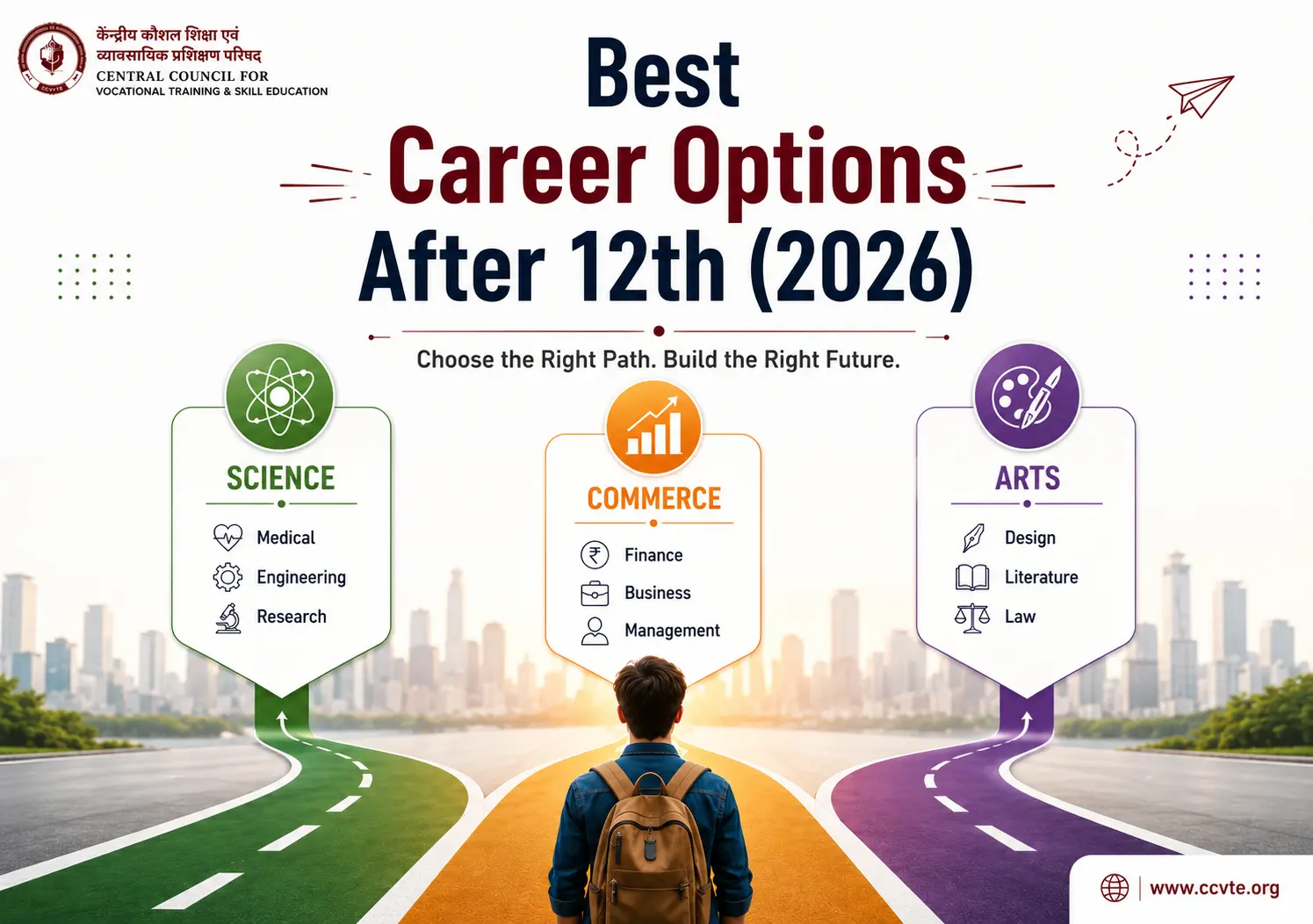
The best career options after 12th include Science, Commerce, and Arts paths like Medical Lab Technician, E-Commerce, Retail Management, and Montessori Teacher Training, all offered as short skill-based courses. These courses lead you into hospitals, retail chains, schools, and logistics companies as a trained professional, often within three months to two years. This guide compares career options by stream, covers course duration, eligibility, and salary potential in easy tables, and lists the most in-demand skills for 2026. Use it to match your interests and stream to a course that builds a real, growing career instead of just a certificate.
Class 12 ends, and a bigger decision begins. The best career options after 12th span Science, Commerce, and Arts streams — from Medical Lab Technician and Patient Care Management to E-Commerce, Retail Management, and Montessori Teacher Training — offered as skill-based courses running 3 months to 2 years. This guide compares each option by stream, breaks down course duration, eligibility, and realistic salary ranges in easy tables, and lists the skills employers are actually hiring for in 2026 — so you move from confusion to a clear next step, whether you studied PCM, PCB, business subjects, or humanities.
Why Choosing the Right Career After 12th Matters
Your career starts with a choice, and that choice shapes the next 40 years of your working life. Career planning turns a vague hope into a clear plan — when your interests match your natural strengths, work stops feeling like a burden and becomes something you improve at every day.
Industry demand is the second factor. A course tied to a growing industry builds a future; one that leads nowhere wastes time and money. That's why smart students study demand before they study syllabus.
Skill development completes the picture. Employers hire people who can do the job, not just people who passed an exam — so the best career option is one that grows your skills, opens real job opportunities, and offers steady long-term growth.
Best Career Options After 12th Science
Science students split into two streams. PCM (Physics, Chemistry, Maths) points toward technology, computer education, and safety management. PCB (Physics, Chemistry, Biology) points toward healthcare, diagnostics, and patient care. Both streams reward practical, hands-on training — and you don't need a five-year degree to start earning. Here are the top career options after 12th Science available at CCVTE:
|
Course Name |
Duration |
Eligibility |
Best For |
Career Opportunities |
|
3M–6M / 1Y–2Y |
12th Science |
Medical Diagnostics |
Medical Lab Technician, Diagnostic Labs, Hospitals |
|
|
3M–6M / 1Y–2Y |
12th Science |
Healthcare Services |
Patient Care Executive, Hospitals |
|
|
3M–6M / 1Y–2Y |
12th |
Industrial Safety |
Safety Officer, Fire Safety Executive |
|
|
3M–6M / 1Y–2Y |
12th |
Agriculture & Dairy |
Dairy Entrepreneur, Farm Supervisor |
|
|
3M–6M / 1Y–2Y |
12th |
Computer Education |
Computer Teacher, Training Institutes |
Entry-level pay in these fields commonly starts in the ₹12,000–₹25,000/month range and climbs quickly with 1–2 years of hands-on experience — Medical Lab Technicians and Patient Care roles tend to move fastest, since hospitals prioritize certified, job-ready staff over fresh graduates with no clinical exposure.
Best Career Options After 12th Commerce
Commerce students hold a natural advantage in fields built on numbers, systems, and people — business operations, retail, logistics, customer service, and digital commerce. The trick is picking a course that connects fast to a job, which is why practical courses focus on real workplace skills: inventory systems, CRM tools, documentation, and e-commerce operations. These are the best career options after 12th Commerce you can start right away:
|
Course Name |
Duration |
Eligibility |
Best For |
Career Opportunities |
|
3M–6M / 1Y–2Y |
12th Commerce |
Supply Chain & Logistics |
Warehouse Executive, Logistics Companies |
|
|
3M–6M / 1Y–2Y |
12th |
Office Administration |
Documentation Executive, Corporate Offices |
|
|
3M–6M / 1Y–2Y |
12th |
Customer Service |
CRM Executive, Sales Coordinator |
|
|
3M–6M / 1Y–2Y |
12th |
Retail Industry |
Store Manager, Retail Executive |
|
|
3M–6M / 1Y–2Y |
12th |
Online Business |
E-Commerce Executive, Digital Store Management |
As online retail keeps expanding, E-Commerce and Warehouse Management roles are among the fastest-growing entry points, with starting pay typically in the ₹13,000–₹28,000/month band and clear promotion paths into store or operations management within 2–3 years.
Best Career Options After 12th Arts
Arts is not a backup — it's a launchpad. Humanities students often carry exactly the strengths modern workplaces need: communication, creativity, empathy, and patience. Teaching and early-childhood education need warm, capable people; the beauty industry needs skilled artists; computer education needs trainers who explain clearly. The best career options after 12th Arts blend creative work with steady income:
|
Course Name |
Duration |
Eligibility |
Best For |
Career Opportunities |
|
3M–6M / 1Y–2Y |
12th |
Preschool Teaching |
Montessori Teacher |
|
|
3M–6M / 1Y–2Y |
12th |
Early Childhood Education |
Nursery Teacher |
|
|
3M–6M / 1Y–2Y |
12th |
Beauty Industry |
Makeup Artist |
|
|
3M–6M / 1Y–2Y |
12th |
Beauty & Wellness |
Beauty Therapist |
|
|
3M–6M / 1Y–2Y |
12th |
Computer Education |
Computer Teacher |
Early-childhood education is booming across India, and trained Montessori/NTT teachers are in steady demand at preschools; Makeup Artistry and Beauty Therapy graduates typically move into salon roles or freelance income within a few months of certification.
Vocational Course vs Traditional Degree — Which Is Better After 12th?
Neither path is universally "better." A vocational course gets you earning faster; a degree is non-negotiable for roles like doctor, engineer, or chartered accountant. Many students now do both — a short skill course right after 12th to start earning, followed by a degree later through distance or part-time study.
|
Factor |
Vocational / Skill Course |
Traditional Degree |
|
Duration |
3 months – 2 years |
3 – 5 years |
|
Cost |
Lower, course-based fees |
Higher, multi-year fees |
|
Job Readiness |
Practical, job-ready from day one |
Mostly theoretical; needs added training |
|
Time to First Salary |
Often within months of enrolling |
Only after full degree completion |
|
Best For |
Fast, hands-on entry into a field |
Roles that legally require a degree (engineering, medicine, law, CA) |
Best Career Options After 12th with High Salary
No course guarantees a fixed salary — but skill-based training builds the abilities that push income upward over time. Several fields stand out for strong salary growth after 12th:
- Healthcare — Medical lab technicians and patient care executives stay in constant demand as hospitals expand.
- IT & Computer Education — Trained computer teachers and digital professionals earn well and grow fast.
- Retail Management — Store managers move up quickly with proven performance.
- Safety Management — Certified safety officers command strong pay in industrial sectors.
- Logistics — Warehouse and supply chain roles expand alongside e-commerce growth.
- Entrepreneurship — Dairy farming and beauty services let you build your own business instead of relying on a fixed salary.
Each path rewards practical, job-ready skills over certificates alone — train well, and your salary climbs with you.
Most Demanding Courses in Future
Some industries grow slowly; others surge. Choosing a course tied to a rising industry protects your career for the next decade. These are the most in-demand fields and why each keeps expanding:
- Healthcare — India's aging population and new hospitals drive steady demand for lab and patient-care staff.
- Digital Skills — Every business now runs online, so digital talent is non-negotiable.
- Computer Education — Schools and institutes need trained computer teachers year after year.
- Safety Management — Stricter industrial regulations make certified safety officers essential.
- Teacher Training — Preschools and nurseries keep multiplying, and so does the need for trained teachers.
- Logistics — Faster deliveries require more warehouse and supply-chain professionals.
- E-Commerce — Online selling grows every quarter, pulling in more trained executives.
- Skill-Based Education — Employers increasingly prefer job-ready graduates over theory-heavy ones.
Related read: Top 10 Best Vocational Courses After 10th
Skill-Based Courses After 12th
Degrees teach theory; skill-based courses teach the job. That difference matters more than ever.
- Practical learning — you train with real tools, real cases, and real workflows.
- Faster employment — most courses run 3 to 24 months, so you start earning sooner.
- Industry-ready skills — you graduate knowing exactly what the job requires.
- Affordable education — short courses cost far less than long degrees.
- Career flexibility — you can specialize, switch fields, or start your own venture.
Many of these programs align with standards set by the National Skill Development Corporation (NSDC), India's central body for vocational skill benchmarks — a useful external reference if you want to verify course credibility.
Which Skill Is Best to Learn After 12th?
If you're asking which single skill matters most after 12th, it's computer literacy paired with clear communication — nearly every entry-level role today, from CRM Executive to Medical Lab Technician, expects both. Beyond that, focus on these — the best skills to learn for a strong, flexible career:
- Computer Skills — the foundation of nearly every modern job.
- Communication Skills — clear speaking and writing set you apart instantly.
- Customer Handling — essential across retail, CRM, and service roles.
- Documentation Skills — accurate records keep offices and companies running.
- Laboratory Skills — core to healthcare and diagnostic careers.
- Teaching Skills — vital for Montessori, nursery, and computer-education roles.
- Safety Management — a specialized, well-paid skill in industrial settings.
- Problem Solving — the ability that gets you promoted.
- Teamwork — no workplace runs without it.
- Basic Digital Skills — from email to online tools, now expected everywhere.
Career Guidance After 12th: How to Choose the Right Option
Ten options, one decision — here's how to make it wisely. Run through this checklist before you enroll:
- Interest — pick work you genuinely enjoy, because passion sustains effort.
- Strengths — play to what you are naturally good at.
- Budget — choose a course you can afford without financial stress.
- Course Duration — decide between quick 3M–6M programs or longer 1Y–2Y ones.
- Future Demand — confirm the industry is growing, not shrinking.
- Job Opportunities — check where the course actually leads.
- Skill Development — prefer courses that build real, usable abilities.
- Career Goals — align the course with where you want to be in five years.
|
Quick Tip • Score each course against the eight points above — the highest scorer is usually your answer. • Then confirm details on the matching CCVTE course page and enroll. |
Conclusion
Your future isn't decided by your marksheet — it's decided by your next move. You now know the best career options after 12th across Science, Commerce, and Arts: the courses, durations, eligibility, and real career opportunities behind each one, plus which fields are growing and how to choose the path that fits you.
Choose with intention. Match your interest to your strength, then match both to real industry demand — skill-based vocational courses give you exactly that edge: practical knowledge, faster employment, and stronger job opportunities than theory alone can offer.
Published by CCVTE — Central Council of Vocational Training and Skill Education Delhi | +91 8595350621 | info@ccvte.org | ccvte.org
Frequently Asked Questions
Find answers to common questions