- +91 8595350621
- info@ccvte.org
- C4/97B, Keshav Puram, Delhi-110035

Skill-Based Education vs Traditional Education in India
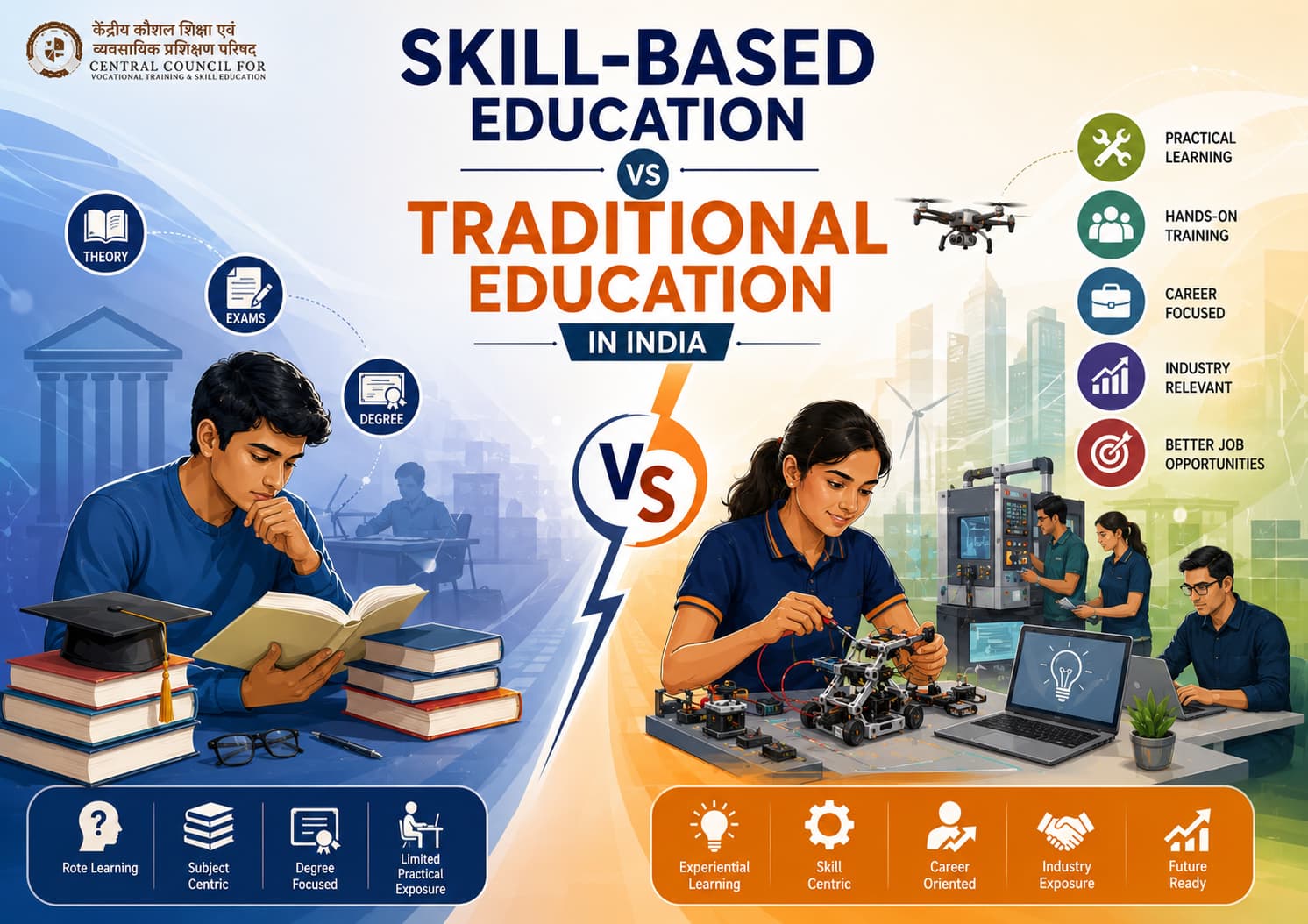
Skill-based education focuses on practical, job-ready training through hands-on learning, while traditional education builds academic depth through structured degrees and theory. In India, skill-based and vocational education prepare students for specific careers faster, whereas traditional education remains essential for degree-mandated professions like medicine, law, and engineering. Neither approach is universally better — the right choice depends on career goals, learning style, and industry demand. This guide compares both paths, explores career opportunities through skill-based education, and explains how combining academic knowledge with practical skills often delivers the strongest long-term career outcomes for Indian students.
Choosing between skill-based education and traditional education is one of the biggest decisions Indian students face today. Skill-based education focuses on hands-on, job-ready training, while traditional education builds academic depth through structured degrees. This article compares both approaches across learning style, career outcomes, and long-term value, so you can decide which path — or combination of paths — fits your goals.
What Is Skill-Based Education?
Skill-based education is a learning model built around practical, job-relevant abilities rather than purely theoretical study. Students learn by doing — through workshops, labs, internships, and real industry tasks — and progress is measured by what they can actually perform, not just what they can recall in an exam.
This approach has grown rapidly in India as employers increasingly look for candidates who can contribute from day one. Courses under this model are usually shorter, more focused, and tied directly to a specific trade or profession.
Common features of skill-based learning include:
● Hands-on training with tools, equipment, or software used in the actual job
● Competency-based assessment (you're evaluated on tasks, not just theory)
● Shorter, more flexible course durations
● Direct alignment with industry requirements
● Mentorship from working professionals rather than only classroom instructors
Examples of skill-based learning in India include diploma and certificate programs in paramedical assisting, fire and safety management, warehouse and logistics operations, nutrition and dietetics, IT support, and various technical trades. Organizations like CCVTE (Central Council for Vocational Training & Education) offer this kind of career-focused, practical training designed to get students workplace-ready faster than a conventional degree program.
What Is Traditional Education?
Traditional education refers to the conventional academic system built around structured curricula, formal degrees, and theoretical learning delivered through schools, colleges, and universities. It follows a fixed progression — school, undergraduate degree, postgraduate degree — with learning assessed mainly through written examinations.
This model has been the backbone of India's education system for decades and remains essential for several career paths.
Traditional education typically involves:
● A broad, structured curriculum covering foundational subjects
● Formal degrees and certifications recognized nationally and internationally
● Emphasis on conceptual understanding, theory, and research methodology
● Longer program durations (typically 3–4 years for undergraduate study)
● Assessment primarily through exams, assignments, and dissertations
Traditional education remains genuinely valuable for professions that legally or structurally require a formal degree — medicine, law, engineering, civil services, academia, and research-based careers. It also builds critical thinking and theoretical grounding that supports long-term intellectual growth, not just immediate employability.
Skill-Based Education vs Traditional Education: Key Differences
Both models serve different purposes, and neither is inherently superior — they're optimized for different outcomes.
|
|
|
|
|
|
|
|
|
|
|
|
|
|
|
|
|
|
|
|
|
|
|
|
|
|
|
|
|
|
|
|
|
|
|
|
|
|
|
|
|
|
|
|
|
|
|
|
It's worth noting that traditional education does teach practical skills in many disciplines — engineering labs, medical clinicals, and law moot courts are all practice-based. The real difference lies in emphasis: skill-based programs are built around job performance from the start, while traditional programs build toward it after a broader academic foundation.
Benefits of Skill-Based Education
Skill-based education offers several advantages for students who want to enter the workforce quickly and with practical confidence.
● Practical knowledge: Students learn tools and processes they'll actually use on the job.
● Industry-relevant skills: Curricula are updated more frequently to match current employer needs.
● Faster career preparation: Shorter course durations mean quicker entry into paid work.
● Hands-on learning: Reinforces retention better than passive theoretical study for many learners.
● Employability: Employers in sectors like healthcare support, logistics, and technical services often value demonstrated competency alongside qualifications.
● Flexibility: Many programs offer part-time, weekend, or modular formats suited to working students.
● Entrepreneurship potential: Practical trade skills can support self-employment or small business ventures.
It's important to be realistic here — completing a skill-based course improves employability but does not guarantee a job or a specific salary. Outcomes still depend on the student's effort, local market demand, and how the skill is applied.
Benefits of Traditional Education
Traditional education continues to offer strengths that skill-based programs typically can't replace.
● Strong academic foundation: Builds broad subject knowledge that supports adaptability across roles.
● Theoretical understanding: Helps students understand why something works, not just how.
● Professional qualifications: Required for regulated professions like medicine, law, and chartered accountancy.
● Research opportunities: Opens pathways into academia, R&D, and policy work.
● Structured learning: Provides a clear, well-recognized progression from school to specialization.
● Degree eligibility: Many government jobs, higher studies abroad, and senior corporate roles still require a formal degree.
For students aiming at careers that are gated by formal qualifications, traditional education isn't optional — it's a prerequisite.
Education and Skill Development: Why Both Matter
The strongest answer to “academic knowledge or practical skills” is usually: both, in the right proportion for your goal.
India's job market increasingly rewards candidates who combine academic grounding with applied skills — digital literacy, communication, problem-solving, and industry exposure. A purely theoretical education without any practical exposure can leave graduates underprepared for real workplace demands. Conversely, narrow skill training without broader knowledge can limit long-term career mobility.
This is why the relationship between education and skill development matters so much in current policy conversations in India. Building both academic understanding and job-ready ability — including softer skills like teamwork, adaptability, and lifelong learning habits — gives students the most durable career foundation, regardless of which path they start on.
Careers Based on Skill-Based Education
There's a wide and growing range of career opportunities through skill-based education in India, spanning both technical and service-oriented sectors:
● Healthcare and paramedical services — lab technicians, patient care assistants, medical billing and coding
● Information technology — IT support, basic software testing, technical helpdesk roles
● Digital skills — digital marketing execution, content operations, e-commerce support
● Logistics and warehouse operations — inventory management, supply chain coordination
● Fire and safety — safety officers, industrial safety compliance roles
● Nutrition and wellness — dietary assistants, wellness coaching support
● Technical trades — electrical, HVAC, and equipment maintenance work
● Business and service-sector skills — customer service, retail operations, hospitality management
These are genuine career options after skill-based education, but it's worth being clear-eyed: completing a short-term course builds capability and opens doors — it doesn't automatically guarantee placement. Students who combine their training with internships, certifications, and continued learning tend to see the strongest career growth through skill-based education.
Role of Vocational Education in India
Vocational education in India refers to structured training programs designed to prepare students for specific trades and occupations, distinct from the general academic track. Unlike purely academic education, vocational programs are built around direct industry needs — from technical trades to service-sector roles.
Key aspects of vocational education include:
● Practical, job-oriented training delivered through labs, workshops, and on-the-job practice
● Curriculum designed in consultation with industry requirements
● Shorter timelines to employment compared to full degree programs
● Career-focused pathways for students who know their target profession early
Vocational education plays a growing role in India's broader skill development ecosystem, supported by national efforts like the Ministry of Skill Development and Entrepreneurship and the National Skill Development Corporation, which work to expand access to structured, industry-aligned training. For students who prefer learning by doing and want a faster route into a specific career, vocational education offers a practical, focused alternative to the conventional degree path.
Skill-Based Education vs Traditional Education: Which Is Better?
There's no universal answer — the right choice depends on the individual student's goals, interests, and circumstances.
Skill-based education may be suitable for:
● Students who learn best through hands-on practice rather than lectures
● Those seeking job-oriented skills for a specific trade or role
● Students interested in vocational or technical careers
● Learners who want to enter the workforce faster with focused, industry-aligned training
Traditional education may be suitable for:
● Careers that legally require a formal degree (medicine, law, engineering, civil services)
● Students drawn to academic, research, or policy-oriented paths
● Learners who want a broad theoretical foundation before specializing
The hybrid approach
Many of the strongest career outcomes today come from combining the two — a formal degree paired with practical certifications, internships, or short-term skill courses. This hybrid model gives students both the credibility of academic qualifications and the readiness that comes from applied training, which is increasingly what employers look for.
How to Choose the Right Education Path
If you're exploring practical options, you can browse CCVTE's full range of courses to see what fits your timeline and career goals.
Use this framework to guide your decision:
1. Career goal — Does your target profession require a specific degree, or is it skill/competency driven?
2. Interest — Do you enjoy hands-on work, or are you drawn to research and theory?
3. Learning style — Do you retain information better through practice or through structured study?
4. Time available — Can you commit 3–4 years, or do you need to start earning sooner?
5. Budget — Degree programs and vocational courses differ significantly in cost.
6. Required qualification — Check whether your target role has a mandatory degree requirement.
7. Industry demand — Research which skills or qualifications employers in your target sector actually prioritize.
8. Practical exposure — Consider how much hands-on experience the program offers.
9. Long-term career plans — Think beyond your first job to where you want to be in 5–10 years.
Future of Skill-Based Education in India
Skill-based education is likely to keep growing in relevance as India's job market continues to shift toward practical, adaptable competencies. Several trends are shaping this direction:
● Digital transformation is creating demand for practical digital skills across nearly every industry, not just tech roles.
● Industry demand for job-ready talent is pushing more employers to value demonstrated competency alongside formal qualifications.
● Reskilling and upskilling are becoming ongoing necessities rather than one-time events, as roles evolve with new technology.
● Lifelong learning is emerging as a baseline expectation, with professionals expected to continuously add practical skills throughout their careers.
While these shifts point toward growing importance for skill-based and vocational training, the pace and shape of this change will depend on evolving policy, industry adoption, and how institutions adapt their offerings — so it's worth staying informed through official sources like the Ministry of Education and AICTE rather than relying on speculation.
Conclusion
Skill-based education and traditional education aren't competitors — they're different tools suited to different goals. The right path depends on your career ambitions, learning style, timeline, and the qualification requirements of your chosen field. For students exploring practical, career-focused options, programs offered through CCVTE in areas such as paramedical courses, warehouse management, fire and safety, and nutrition and dietetics can provide a direct route into skilled employment — while those aiming for degree-mandated professions will still need the traditional academic route. For many students, the smartest strategy is a blend of both: solid academic grounding paired with real, demonstrable skills.
Published by CCVTE — Central Council of Vocational Training and Skill Education Delhi | +91 8595350621 | info@ccvte.org | ccvte.org
Enquiry About Your Course
Recent Posts


Frequently Asked Questions
Find answers to common questions