- +91 8595350621
- info@ccvte.org
- C4/97B, Keshav Puram, Delhi-110035

Dairy Farming Certificate Course: India's Best Programs
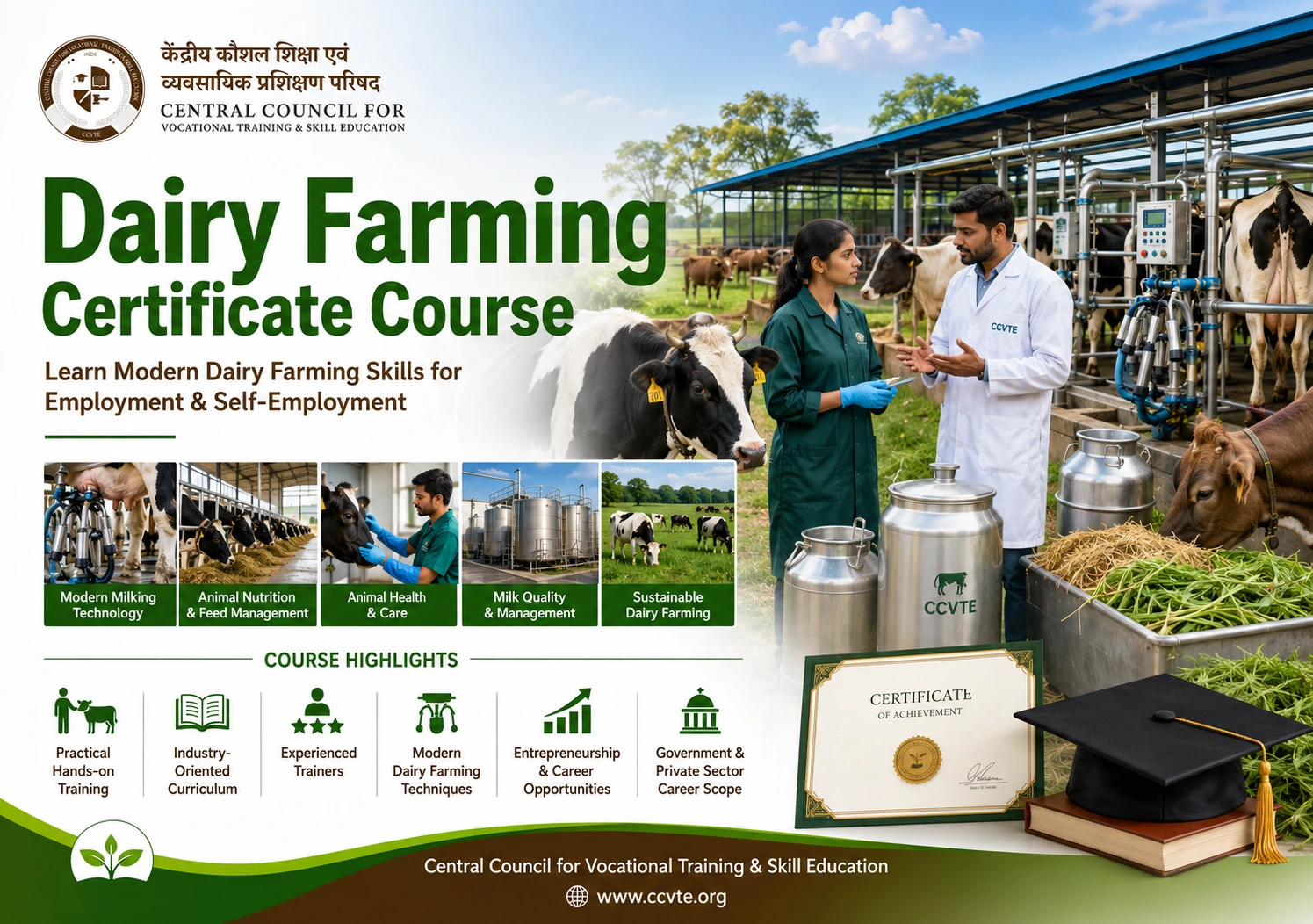
A dairy farming certificate course is a practical skill-based program that prepares students, aspiring entrepreneurs, and working professionals for careers in India's growing dairy industry. It teaches essential skills such as animal husbandry, milk production, herd management, breeding, nutrition, and modern farm operations. After completing the course, learners can explore career opportunities in commercial dairy farms, milk processing companies, cooperatives, agribusinesses, or start their own dairy farming business. This guide explains the eligibility, course duration, syllabus, specializations, career opportunities, expected salary, and future scope to help you choose the right dairy farming course based on your career goals.
Looking for practical dairy farming courses that lead to real jobs or your own farm? CCVTE (Center for Career and Vocational Training Education), a Delhi-based vocational skill training institute, offers a Skill Development Program in Dairy Farming with four flexible durations: 3 months, 6 months, 1 year, and 2 years. Each is a certificate course built around hands-on learning, not just textbooks. You study dairy production, animal care, feeding practices, farm economics, and modern milking methods.
The minimum qualification is just 10th pass, so students, graduates, and working professionals can all apply. India is the world's largest milk producer, and its dairy sector is one of the fastest-growing parts of the rural economy. As commercial farms, co-operatives, and processing plants keep expanding, trained people are in short supply. That gap is exactly why a focused dairy farming certificate can turn your interest into a stable income. This guide walks you through the syllabus, career paths, eligibility, and how to enroll.
Why Choose a Dairy Farming Certificate Course?
A dairy farming certificate course gives you job-ready skills without the long wait and heavy fees of a full degree. Here is why it makes practical sense for most learners in India.
- Faster entry into work: You can finish a certificate in as little as 3 months and start applying for jobs or setting up a small unit, instead of spending three or four years in a classroom.
- Lower cost, real skills: Vocational training focuses on what you actually do on a farm, so your money goes toward practical ability rather than long theory-heavy coursework.
- Flexible duration: With 3-month, 6-month, 1-year, and 2-year options, you pick the level that matches your goal, whether that is quick employment or a management-level role.
- Strong sector demand: Milk production keeps rising, and employers now prefer candidates with formal dairy farming training over those with no certificate at all.
- Hands-on learning over classroom theory: A certificate course puts you on actual farm setups, working with animals, equipment, and feed routines from early in the program. That practical exposure is what most degree programs delay until the final year, if they include it at all.
- Growing demand from co-operatives and private dairies: Large dairy co-operatives and private processing companies are expanding their operations and increasingly look for people with certified, structured training, not just informal experience. A dairy farming certificate signals that you understand both the animal care and the operational side of running a productive unit.
The result is a shorter, affordable path to a career in a sector that is growing every year. Next, let's look at exactly what you will study.
What the Course Covers: Syllabus by Level
CCVTE's syllabus builds step by step. Each higher level includes everything from the level below, plus new, more advanced topics. This structure lets you start small and grow toward a management role. Below is the full breakdown across all four certificate durations.
3-Month Certificate Course
This is the foundation level, ideal if you want core skills fast.
- Introduction to Dairy Farming
- Dairy Farm Management basics
- Animal Nutrition and Feeding
- Milking Techniques and Equipment
After completing this level, you will be able to carry out daily farm tasks independently — feeding livestock correctly, operating basic milking equipment, and maintaining hygiene standards that affect milk quality. This is enough to take up an entry-level role on a working farm or begin a small self-employment unit.
6-Month Certificate Course
Includes all 3-month modules, plus deeper practical topics.
- Dairy Herd Management
- Disease Prevention and Management
- Dairy Farm Equipment and Machinery
- Milk Quality and Processing Techniques
At this level, you gain the ability to manage a full dairy herd, identify and respond to common animal health issues, and assess milk quality at the source. You will be equipped for roles that require both animal care and an understanding of the processing end of the chain.
1-Year Certificate Course
Includes all 6-month modules, plus business and field skills.
- Environmental Management
- Farm Financial Management
- Dairy Farm Marketing and Sales
- Practical Dairy Farming Skills
By the end of this level, you will be able to manage a dairy operation as a business — planning costs, tracking income, and making decisions about feed, staffing, and marketing. This makes you suitable for supervisory or management positions on commercial farms and in co-operative organizations.
2-Year Certificate Course
Includes all earlier modules, plus advanced and specialized subjects.
- Advanced Animal Health Management
- Sustainable Dairy Farming Practices
- Farm Management Systems
- Research and Innovation in Dairy Farming
Completing the full two-year program positions you for senior roles in herd management, farm consultancy, or applied dairy research. You will have the depth to implement sustainable systems, handle complex health challenges across a large herd, and contribute to innovation in dairy farm management practices.
Across these levels, you build strength in animal husbandry, modern milking techniques, dairy herd management, and complete dairy farm management. That mix of theory and hands-on practice is what makes this a genuine certificate course in dairy management rather than a purely academic program. Now that you know what you'll learn, here's how the levels and roles line up.
Specializations and Course Duration Options
CCVTE prepares you for a wide range of roles across the dairy industry. The table below maps each certificate duration to who it suits best, so you can choose with confidence.
|
|
|
|
|
|
|
|
|
|
|
|
|
|
|
|
|
|
|
|
The program also aligns your learning with recognized industry specializations:
- Dairy Manager
- Dairy Herd Manager
- Dairy Chemistry
- Farm Manager
- Agricultural Specialist
- Biological Science Technician
- Research Assistant
- Quality Assurance
- Dairy Nutritionist
- Food Science
Because higher levels stack on top of lower ones, you can begin with a short certificate and later return for an advanced one as your ambitions grow. This flexibility matters most when you look at where these skills can take you.
Career Opportunities and Job Roles After the Course
Completing a dairy farming certificate opens doors in both private companies and government or research bodies. The dairy industry needs trained hands at every stage, from the farm to the processing plant. Here are the main career opportunities by sector.
Private and Commercial Sector
- Dairy Farm Manager
- Dairy Production Specialist
- Herd Manager
- Dairy Nutritionist
- Milking Technician
- Dairy Breeding Specialist
- Quality Control Inspector
- Dairy Farm Equipment Technician
- Sales and Marketing Representative
- Dairy Processing Plant Operator
A Dairy Farm Manager oversees the full day-to-day operation of a dairy unit — scheduling feeding routines, monitoring animal health, managing farm labor, and ensuring that milk output meets both volume and quality targets. It is a role that combines animal knowledge with practical leadership, and farms prefer candidates who have formal dairy farm management training behind them. A Quality Control Inspector, on the other hand, works at the point where farm output meets processing and distribution — testing milk samples for fat content, bacterial count, and contamination, and flagging batches that fall outside acceptable standards. This role is increasingly important as dairy brands and co-operatives face stricter food safety requirements.
Government and Research Sector
- Agricultural Extension Officer
- Research Scientist (Dairy Farming)
- Farm Consultant
Top Hiring Organizations
- Commercial dairy farms
- Dairy processing plants
- Veterinary clinics
- Dairy research institutions
- Co-operative dairy associations
- Agricultural extension services
- Agribusiness consultancies
A certificate gives you a clear edge over untrained applicants competing for the same roles. Beyond employment, many graduates also start their own dairy units. Before you enroll, it helps to confirm you meet the simple entry requirements.
Who Should Take This Course?
This course is built to be accessible, so the entry rules are deliberately broad. If you fit any of the profiles below, you can apply.
Eligibility:
- Minimum qualification: 10th pass (High School)
- Higher qualifications welcome: 12th pass students, graduates, and working professionals
- Age: No upper age limit
- Background: Prior farming experience is not required
- Gender: Open to both male and female candidates
- Mode: Suits fresh students and working professionals through flexible learning options
This course is a strong fit for:
- 12th pass students, especially those from science or agriculture streams, who want a practical, employment-focused path without committing to a multi-year degree. The certificate format means you can be work-ready in as little as 3 to 6 months and start building real-world experience while your peers are still in lecture halls.
- Rural and semi-urban individuals who already live near livestock or agricultural land and want to convert that proximity into a productive income source. The program teaches the kind of applied dairy skills — from milking techniques to animal nutrition — that directly improve what you can earn from a farm setup you may already have.
- Career switchers who are moving into the dairy and agriculture sector from another line of work and need a structured, credible foundation to make that transition confidently. A dairy farming certificate demonstrates to employers and lenders alike that you have made a serious, trained commitment to the field.
- Parents researching a practical and affordable vocational route for their children after school or college, particularly in a sector with consistent employment demand. Dairy farming training offers a career track that is both self-employment-friendly and open to formal employment across farms, co-operatives, and processing companies.
If you see yourself in any of these groups, the next question is usually: why pick CCVTE over other options?
Why Choose CCVTE for Dairy Farming Training?
CCVTE stands out as a dairy training centre because it keeps the program flexible, affordable, and rooted in real practice. Here is what you get.
- Four flexible durations: Choose 3 months, 6 months, 1 year, or 2 years, and match the certificate to your time and goals rather than being locked into one long track.
- Affordable skill development program: As a vocational institute, CCVTE focuses your investment on practical ability, making it a budget-friendly alternative to lengthy degree routes.
- Hands-on training: The curriculum combines theory with practical dairy farm exposure, covering animal husbandry, milking techniques, and dairy herd management so you learn by doing. This includes working with actual milking equipment, understanding feed schedules for different breeds, and applying disease prevention protocols in practical settings — not just reading about them.
- Recognized certification: On completion, you earn a dairy farming certificate that signals formal training to employers, co-operatives, and lenders. When applying for farm management jobs or approaching financial institutions for agricultural loans, a recognized certificate from an accredited vocational institute carries measurable weight in your favor.
- Wide accessibility: With a 10th-pass minimum and no upper age limit, the program welcomes fresh students, working professionals, and career switchers alike.
This blend of choice, cost, and practical depth is what makes CCVTE's dairy farming training a reliable starting point. Below are answers to the questions most learners ask before signing up.
Conclusion
India's dairy sector is one of the strongest pillars of the rural economy, and it needs skilled, certified people to keep growing. CCVTE's dairy farming courses give you a practical, affordable, and flexible way in, whether you want quick employment, a management role, or your own farm. With durations from 3 months to 2 years, a broad 10th-pass eligibility, and hands-on training in animal husbandry, milking techniques, and dairy herd management, the program meets you wherever you are starting from.
Admissions for the 2026 intake are open now. Visit the CCVTE Dairy Farming Course page at ccvte.org/skill-courses/agriculture/dairy-farming, confirm your eligibility, and enroll today to take your first step toward a certified career in dairy farming.
Published by CCVTE — Central Council of Vocational Training and Skill Education Delhi | +91 8595350621 | info@ccvte.org | ccvte.org
Frequently Asked Questions
Find answers to common questions