- +91 8595350621
- info@ccvte.org
- C4/97B, Keshav Puram, Delhi-110035

What Is E-Business? Meaning, Types, Benefits, and Examples
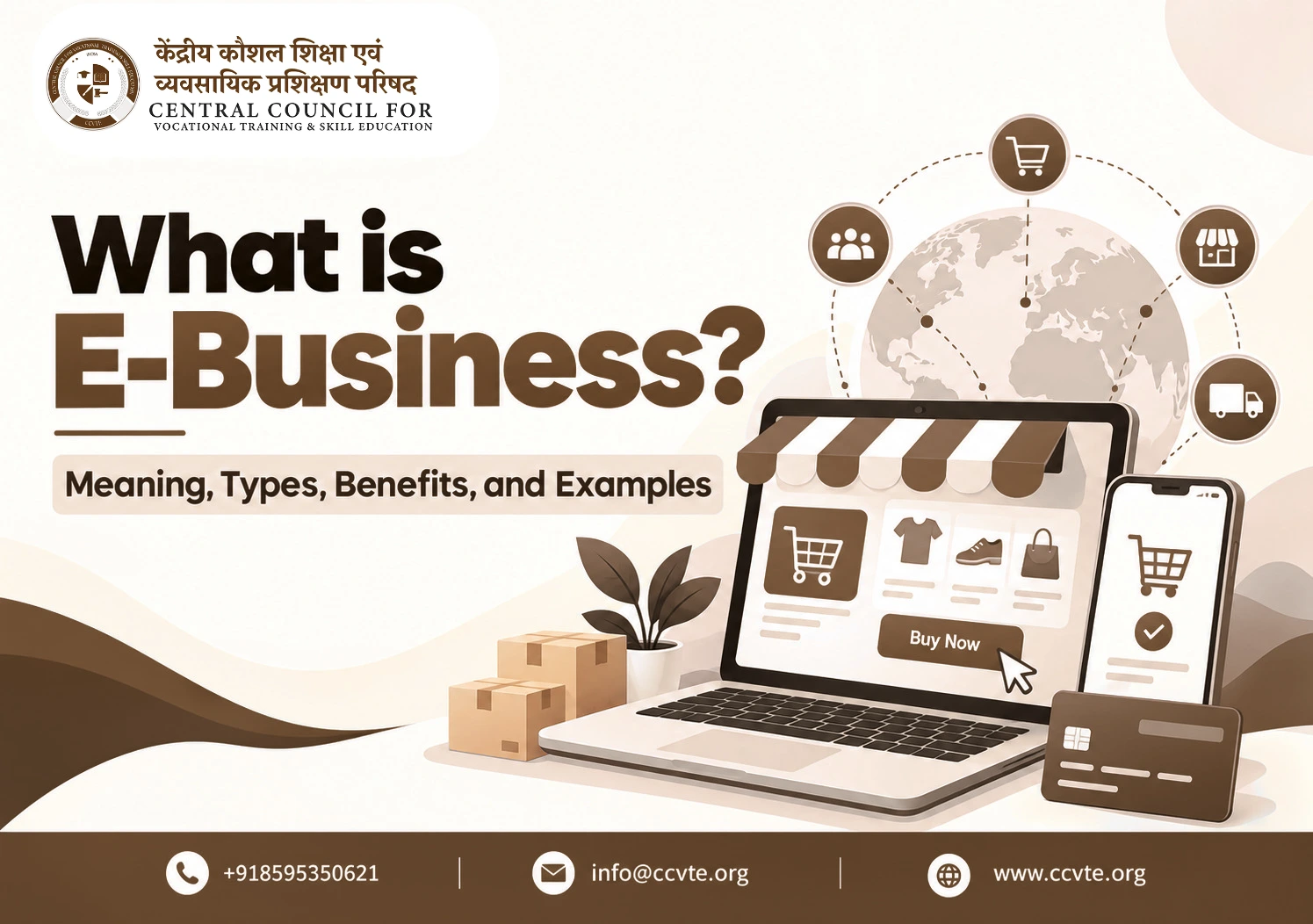
A plain-language guide to e-business: meaning, types, benefits, risks, examples and how to start one in India.
E-business, short for electronic business, means running any part of a company through the internet and digital technology. That covers selling products online, but also buying supplies, managing stock, taking payments, serving customers and coordinating with partners. Most people use the word as a synonym for online shopping, and that is where the confusion starts. If you have booked a train ticket on IRCTC, paid a supplier through UPI or tracked a parcel on your phone, you have already used an e-business system without calling it that. This guide explains the meaning of e business in plain language, then covers how it works, the main types, the benefits, the risks and real examples. It also shows how it differs from e-commerce and how a beginner in India can start one. Each section opens with a short answer, so you can skim or read all the way through.
Key Takeaways
• Simple definition: E-business means conducting business activities such as sales, purchasing, payments and support through digital networks.
• Bigger than e-commerce: E-commerce is only the buying and selling part. E-business also includes supply chain, HR, marketing and internal systems.
• Five common types: B2B, B2C, C2C, C2B and B2G describe who is trading with whom.
• Real revenue models: Marketplaces, subscriptions, software services, advertising and digital products all count.
• Clear benefits: Lower running costs, round-the-clock sales, wider reach and better customer data.
• Real risks: Cyber attacks, payment fraud, tough competition and dependence on technology need planning from day one.
• Easy to begin: In India, a small team can start with a website, a payment gateway, GST registration where applicable and a simple customer support process.
What Is E Business? Meaning in Simple Words
E business is the practice of carrying out business activities over the internet and other digital networks. It includes buying and selling, but also production planning, supplier coordination, marketing, payments, customer support and internal operations. If a business process runs on software and a network instead of paper, phone calls or a counter, it belongs to e business.
- Meaning of E Business in One Line: The meaning of e business is doing business electronically. The “e” stands for electronic. A neighbourhood tailor who takes orders on WhatsApp, collects money by UPI and tracks fabric stock in a spreadsheet is running a small e-business, even if she has never used the word.
- Where the Term Came From: IBM popularised the phrase in the late 1990s, when companies began connecting sales, suppliers and internal systems over the internet. Back then it described large corporate projects. Today it describes almost any business, from a one-person design studio to a national retailer.
- Why It Matters Today: Customers now compare prices on a phone before they walk into a shop. Suppliers expect digital orders. Banks expect digital records. A business that cannot operate online is not just missing a sales channel. It is missing the way customers, partners and regulators now expect to deal with it.
How Does an E Business Work?
An e-business works by moving the steps of a normal business onto digital systems. A customer finds you through search or social media, orders on a website or app, pays through a gateway, and receives a product or service while software records every step. Behind the screen, other systems manage stock, billing and delivery.
Core Components
Most setups share the same building blocks:
• A website or mobile app where customers browse and order
• A payment gateway for cards, UPI and net banking
• Inventory and order management software
• A customer relationship management (CRM) tool for enquiries and follow-ups
• Digital marketing channels such as search, email and social media
• Security tools, including SSL certificates and fraud checks
- A Typical Order, Step by Step: A student orders a laptop bag online. The site confirms stock, the gateway takes payment, the warehouse system prints a label, a courier app tracks the parcel, and an automated message asks for a review a week later. No step needed a paper form.
- The Technology Behind It: Cloud hosting, mobile apps, APIs that let systems talk to each other, and analytics dashboards do the heavy lifting. Artificial intelligence now sits on top, powering product recommendations, chatbots and demand forecasts.
E Business vs E-Commerce
E-commerce is the buying and selling of goods or services online. E-business is the wider umbrella that includes e-commerce plus every other digital process a company uses to operate. All e-commerce is e-business, but not all e-business is e-commerce.
Side-by-Side Comparison
|
|
|
|
|
|
|
|
|
|
|
|
|
|
|
|
|
|
|
|
A Quick Example to Remember
A bank that lets you open an account on an app is doing e-business. A shopping site that sells you a pair of shoes is doing e-commerce. A retailer that also manages vendors and payroll digitally is doing both.
Types of E Business
Types of e-business are usually grouped by who is trading with whom. The five most common are business to business (B2B), business to consumer (B2C), consumer to consumer (C2C), consumer to business (C2B) and business to government (B2G).
B2B, B2C, C2C, C2B and B2G
• B2B: One company sells to another. Examples include wholesale platforms and software sold to firms.
• B2C: A company sells to individual buyers, like an online clothing store.
• C2C: Individuals trade with each other through a platform, such as a second-hand marketplace.
• C2B: Individuals offer skills or content to companies, for example freelancers and stock photo creators.
• B2G: Businesses serve government bodies, often through public tender portals.
Types Based on Revenue Model
Another way to sort them is by how the business earns money. Common models include marketplaces that charge commission, subscription services, software as a service (SaaS), advertising-led platforms, online courses and other digital products, and affiliate selling. Many companies mix two or three of these.
Which Type Should a Beginner Pick?
B2C and C2B-style freelance work are the easiest to start because they need little capital. B2B usually takes longer to win trust, but orders are larger and repeat business is common.
Benefits of E-Business for Companies and Customers
The main benefits of e-business are lower costs, wider reach, faster service and better data. Companies save on rent, paperwork and manual coordination, while customers gain convenience and choice.
Benefits for Businesses
• Round-the-clock sales: Your store never closes.
• Wider reach: A seller in Jaipur can serve a buyer in Chennai.
• Lower overheads: Fewer physical premises and less manual data entry.
• Better data: Every click and order shows what customers actually want.
• Easy scaling: Adding a new product line takes days, not months.
- Benefits for Customers: Buyers can compare prices, read reviews, pay in seconds and get doorstep delivery. For students and working professionals, that saves hours every week.
- The Honest Trade-Off: Low entry costs also mean low barriers for competitors. An online store can be copied in a week. What lasts is service quality, trust and a clear reason for customers to return.
Limitations and Risks of E-Business
E-business carries real risks: cyber attacks, payment fraud, system failures, heavy competition and customer distrust. None of them is a reason to stay offline, but each needs a plan before launch.
- Security and Fraud: Stolen card details, fake orders and phishing emails hit small sellers as often as large ones. Use a reputed payment gateway, keep software updated and never store card numbers yourself.
- Technology and Logistics Problems: A crashed website on a festival sale day costs real money. Late deliveries and returns also eat margins quickly, especially for low-priced goods.
- Trust and Legal Duties: Customers cannot touch the product, so they rely on reviews, clear return policies and visible contact details. You also need to follow the Information Technology Act, GST rules and consumer protection norms that apply to online sellers in India.
E-Business Examples You Already Use
Well-known e-business examples include Amazon and Flipkart for retail, IRCTC for ticketing, Zomato for food delivery, Uber for rides, Netflix for streaming and Coursera for online learning. Each runs its main operations through digital systems.
Examples by Type
• B2C: Amazon and Flipkart sell products directly to shoppers.
• C2C: OLX lets individuals sell used goods to each other.
• B2B: Platforms such as IndiaMART connect manufacturers with business buyers.
• SaaS: Salesforce and Zoho sell business software on subscription.
• Services: IRCTC handles government railway bookings online, and Zomato connects restaurants, riders and diners.
What These Examples Have in Common
They all solve a specific problem, make payment easy and use data to improve the next order. None of them became popular because of a fancy website alone.
How to Start an Online Business in India
You can start an online business in India by choosing a product or service, validating demand, registering the business, building a simple website or storefront, setting up payments and promoting it. A small team can launch in a few weeks.
Steps to Begin
1. Pick a niche where you understand the customer’s problem.
2. Test demand with a small group before spending on stock.
3. Register your business and obtain GST registration if the law requires it for your turnover or category.
4. Build a website or open a seller account on an existing marketplace.
5. Connect a payment gateway that supports UPI, cards and net banking.
6. Promote through search, social media and email.
7. Track orders, complaints and repeat purchases every week.
Skills and Courses That Help
Digital marketing, basic accounting, supply chain knowledge and customer service matter more than coding. Students interested in the field can look at business, commerce, IT and vocational programmes that cover online operations.
The Future of E-Business
E-business is moving toward AI-driven personalisation, voice shopping, faster payments and open digital networks. Businesses that adapt early will find it easier to compete.
AI, Voice and Mobile: Chatbots already answer routine queries, and voice assistants now take simple orders. Since most Indian users browse on phones, mobile-first design is no longer optional.
Open Networks and Digital Payments: UPI has made small payments almost free of friction, and the Open Network for Digital Commerce (ONDC) aims to let small sellers reach buyers across platforms. Both lower the cost of entry for new e-businesses.
Checklist
1. You can explain in one sentence what you sell and to whom.
2. Your website or storefront loads fast on a mobile phone.
3. Payments, refunds and invoices work without manual steps.
4. Customer data is stored securely.
5. You have a clear delivery and return policy.
6. You track sales, traffic and complaints in one place.
7. Someone owns customer support and replies within a day.

Frequently Asked Questions
Find answers to common questions