- +91 8595350621
- info@ccvte.org
- C4/97B, Keshav Puram, Delhi-110035

Sewing Machine Operator: Skills, Job Opportunities, and Career Guide
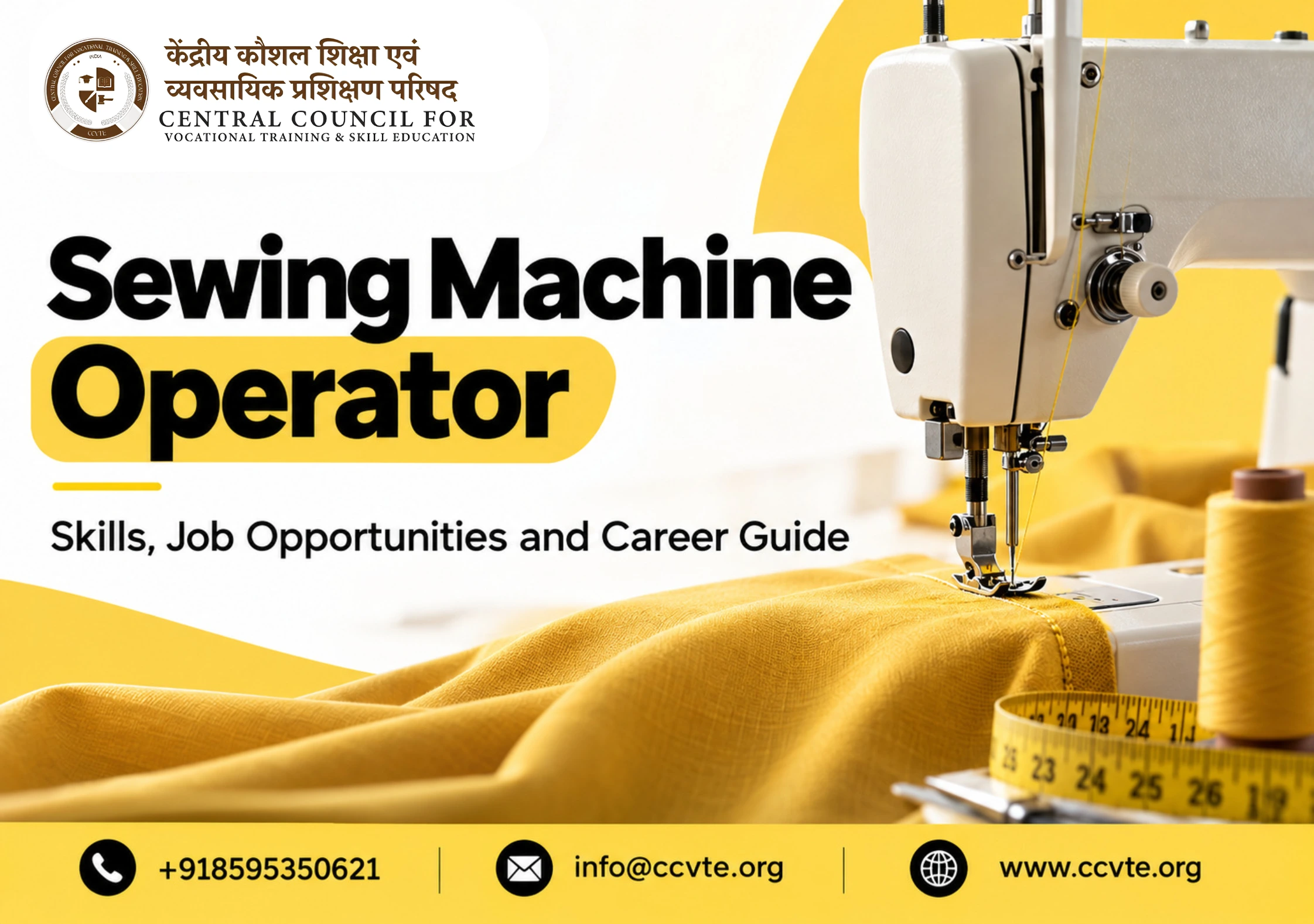
What a sewing machine operator does, the skills employers want, salary in India and how to get your first job.
A sewing machine operator is a skilled worker who runs industrial or domestic sewing machines to stitch garments, uniforms, home textiles and bags, usually in a factory, export house or tailoring unit. In India you can start this career without a college degree, using short skill training and regular practice, and your pay rises with speed, stitch quality and the number of machines you can handle. The work looks simple from outside. Inside a production line, one wrong thread tension can spoil a whole bundle of collars, and employers pay well for operators who catch that before it happens. Garment hubs such as Tiruppur, Ludhiana, Noida, Gurugram and Bengaluru hire in large numbers all year. This guide explains the daily work, the skills that matter, the salary you can expect and the exact steps to get hired.
Key Takeaways
• Clear definition: A sewing machine operator stitches fabric products on industrial or domestic machines, mostly inside garment factories, export houses and tailoring units.
• Low entry barrier: Short skill training and daily practice can get you a trainee role, so beginner jobs are realistic even without a degree.
• Skills that pay: Speed helps, but clean stitching, correct thread tension and the ability to read a work ticket decide how fast you move up.
• Salary reality: Published estimates for India place most monthly pay in the low to mid twenty-thousand rupee range, while small units can pay less and skilled line operators earn more.
• Pay structure: Many factories pay per piece or add production incentives, so your output and rejection rate shape your income.
• Growth path: Operators move up to line leader, quality checker, machine mechanic or production supervisor.
• Training routes: Skill India courses, the ITI sewing trade, factory trainee schemes and private institutes all lead to a first job.
• Self-employment: With experience you can take job work from boutiques, run a home unit or open a tailoring shop.
What Is a Sewing Machine Operator?
A sewing machine operator joins pieces of fabric into finished or semi-finished products using a sewing machine. In a factory, that usually means stitching one part of a garment, such as a collar, sleeve, pocket or side seam, again and again at speed and with the same quality every time. In a small unit or boutique, the same person may stitch a whole garment from start to finish.
The role in simple words
Think of an assembly line where each person owns one step. The operator is the person who owns the stitching step. Fabric arrives already cut, the operator sews it to a standard, and the next person trims, presses or checks it.
Operator, tailor and machinist: what is the difference?
A tailor measures a customer, cuts fabric and fits a garment for one person. An operator mostly works from cut pieces and a work ticket and sews in volume. A machinist is often a more experienced operator who can handle several machine types or a full garment. The titles overlap, and each company uses them a little differently, so read the job description rather than the title.
What Does an Operator Do on a Typical Shift?
Most shifts follow a steady rhythm, and the day is measured in pieces completed and pieces rejected.
Daily tasks on the floor
You collect a bundle of cut pieces with its work ticket, set up the machine with the right needle and thread, and sew your assigned operation. You check your own stitching against a sample, fix small faults, clear thread jams and pass the bundle on. You also tell the supervisor when a machine skips stitches or the fabric puckers, because small faults grow quickly at production speed.
Machines you will meet
The first machine most beginners learn is the single needle lockstitch machine. After that come the overlock or serger for finishing edges, the flatlock for sportswear and knitwear, the buttonhole and button attach machines, and bartack machines that reinforce stress points like pocket corners. Some factories also run programmable pattern sewers and embroidery machines, and operators who can run these are paid more.
Sewing Machine Operator Skills Employers Look For
Hiring managers watch your hands for about ten minutes during a trade test. That short test tells them more than a certificate does.
Technical skills
• Threading, bobbin winding and setting thread tension correctly
• Choosing the right needle size and type for the fabric
• Sewing straight lines, curves, corners and a consistent seam allowance
• Reading a work ticket, sample garment or basic technical sheet
• Daily cleaning and oiling, and changing a broken needle safely
• Handling different fabrics, from stable cotton to slippery satin and stretch knits
Soft skills
Stamina and steady focus matter because the job involves long hours of repeated work. Counting pieces accurately, following spoken instructions and working alongside a line team count too. Basic reading in Hindi, English or your local language helps you understand tickets and safety notices.
The skill most guides skip
Diagnosing the problem before calling the mechanic. Skipped stitches on stretch fabric, for example, usually point to the wrong needle type rather than a faulty machine. An operator who knows this saves line time, and supervisors remember those people when promotions come up.
How to Become a Sewing Machine Operator
If you want the short route, follow these five steps in order.
1. Confirm you meet the basic eligibility, which is usually literacy, a minimum age of 18 and good eyesight and hand coordination.
2. Join a short training course or a factory trainee programme.
3. Practise daily, starting with straight lines, then curves, then collars and cuffs.
4. Prepare a few neatly stitched sample pieces to show in a trade test.
5. Apply for trainee operator roles in a nearby garment cluster.
Eligibility and age
There is no single national rule. Most factories ask for basic literacy, often Class 8 or Class 10 pass, and hire from 18 years. Some premium export units prefer a certificate, but many small and mid-size units hire on the strength of the trade test alone.
Training options in India
You have four practical routes. Short skill courses under Skill India, including those delivered through PMKVY training centres and the apparel sector skill council, are one. The ITI trade in sewing technology is another. Private tailoring and fashion institutes run machine operation courses, and many factories train new hires in-house for a few weeks. Check the current course list and fees at your nearest skill centre, because schemes and centres change.
How long does it take to learn?
With regular practice, most learners reach a basic production level in a few months. Speed comes later. Do not chase speed in the first month, because a fast operator with crooked seams gets rejected, and a slower operator with clean seams gets hired.
Build proof of skill
Stitch a plain shirt collar, a pocket and a straight side seam, and keep them in a folder. Bring a training certificate if you have one. At a walk-in interview this small sample shows your standard far better than a spoken promise.
Job Opportunities in India’s Garment Sector
Demand for operators is spread across the apparel sector and several neighbouring industries.
Where the jobs are
• Garment export houses and domestic apparel factories
• Knitwear and hosiery units, strong in Tiruppur and Ludhiana
• Uniform, workwear and school wear manufacturers
• Home textile units making bedsheets, curtains and cushion covers
• Bag, luggage and footwear workshops
• Automotive seat cover and upholstery makers
• Boutiques, tailoring shops and hospital linen suppliers
Sewing Machine Operator Jobs for Beginners
Entry roles are usually titled trainee operator, helper or line helper. You start on simple operations, such as hemming or attaching labels, while a senior operator checks your work. Look for openings through walk-in drives near garment clusters, local skill centres, college and ITI placement cells, and job apps such as Apna, WorkIndia and Naukri. Carry copies of your ID and your sample pieces. Be ready to answer one question clearly: which machines can you run?
How to check that a job is genuine
Never pay a fee to get a factory job. A genuine employer gives an appointment letter that states your pay, working hours and overtime terms. Ask whether the factory provides PF and ESI where applicable. Be especially careful with agents offering jobs abroad. Verify the agency and the employer before you hand over documents or money.
Sewing Machine Operator Salary in India
The direct answer: WageIndicator’s 2025 India data puts most monthly pay for a sewing machine operator at roughly ₹21,000 to ₹28,000. Its figures for starting pay and long-service pay spread much wider than that. Real offers vary a lot by city, factory size and skill. Small tailoring units in smaller towns often pay well below that range, while experienced operators on specialised machines in export factories can earn above it.
What decides your pay
• Location: Large garment clusters and metro-adjacent factories generally pay more than small town units.
• Factory type: Export houses with compliance audits often follow wage rules more closely than very small workshops.
• Machine skill: Operators who handle overlock, flatlock and programmable machines earn above single needle beginners.
• Speed and quality: Fewer rejected pieces mean a better rating and a stronger case for a raise.
• Overtime and incentives: Extra hours and production targets add to take-home pay, so read the terms in your appointment letter.
Fixed monthly pay versus piece rate
Some employers pay a fixed monthly wage. Others pay per piece, with a minimum guaranteed amount. Piece rate rewards fast, accurate operators, but it can swing from month to month when orders slow down. Ask which system applies, and ask what happens to your pay during low-order weeks.
How to grow your salary
Learn a second and third machine type, keep your rejection count low and ask for a trade test when you think you have outgrown your grade. Operators who move from basic to specialised work usually see the biggest jump. State minimum wage rules also differ, so check the current rate for skilled and semi-skilled workers in your state.
Career Growth After You Start as an Operator
The ladder is short but real. A trainee becomes a regular operator in a few months, then a senior or specialised operator. From there you can become a line leader, a quality checker, a machine mechanic or a floor supervisor. Mechanics are especially in demand because every line needs someone who can fix a machine fast. Automation is growing in larger factories, so learning to run programmable sewing units protects your future income. Some operators go further and start their own job work unit with two or three machines, taking orders from local boutiques and small brands.
Common Beginner Mistakes and How to Fix Them
• Chasing speed too early: Hold a steady pace until your seams stay straight at that pace, then raise it slowly.
• Ignoring needle choice: A blunt or wrong needle causes skipped stitches and puckering. Change it at the first sign of trouble.
• Skipping daily cleaning: Lint in the bobbin area causes jams. Clean and oil at the start of each shift.
• Poor posture: Sit with your back supported and the fabric at a comfortable height to avoid neck and back strain.
• Working without guards: Keep the needle guard and finger guard in place, and wear an eye guard if your unit provides one.
Quick Checklist
1. Learn the basics of the single needle lockstitch machine first.
2. Practise straight lines, curves and corners every day.
3. Understand thread tension, needle types and common stitch faults.
4. Join a skill course or a factory trainee programme.
5. Prepare three or four neat sample pieces for the trade test.
6. Apply to trainee operator roles in a nearby garment cluster.
7. Ask about pay type, overtime, PF and ESI before accepting an offer.
8. Add a second machine type within your first year.
Frequently Asked Questions
Find answers to common questions