- +91 8595350621
- info@ccvte.org
- C4/97B, Keshav Puram, Delhi-110035

Pre Primary Teacher Training Course: Eligibility, Qualification, Syllabus, Career & Jobs
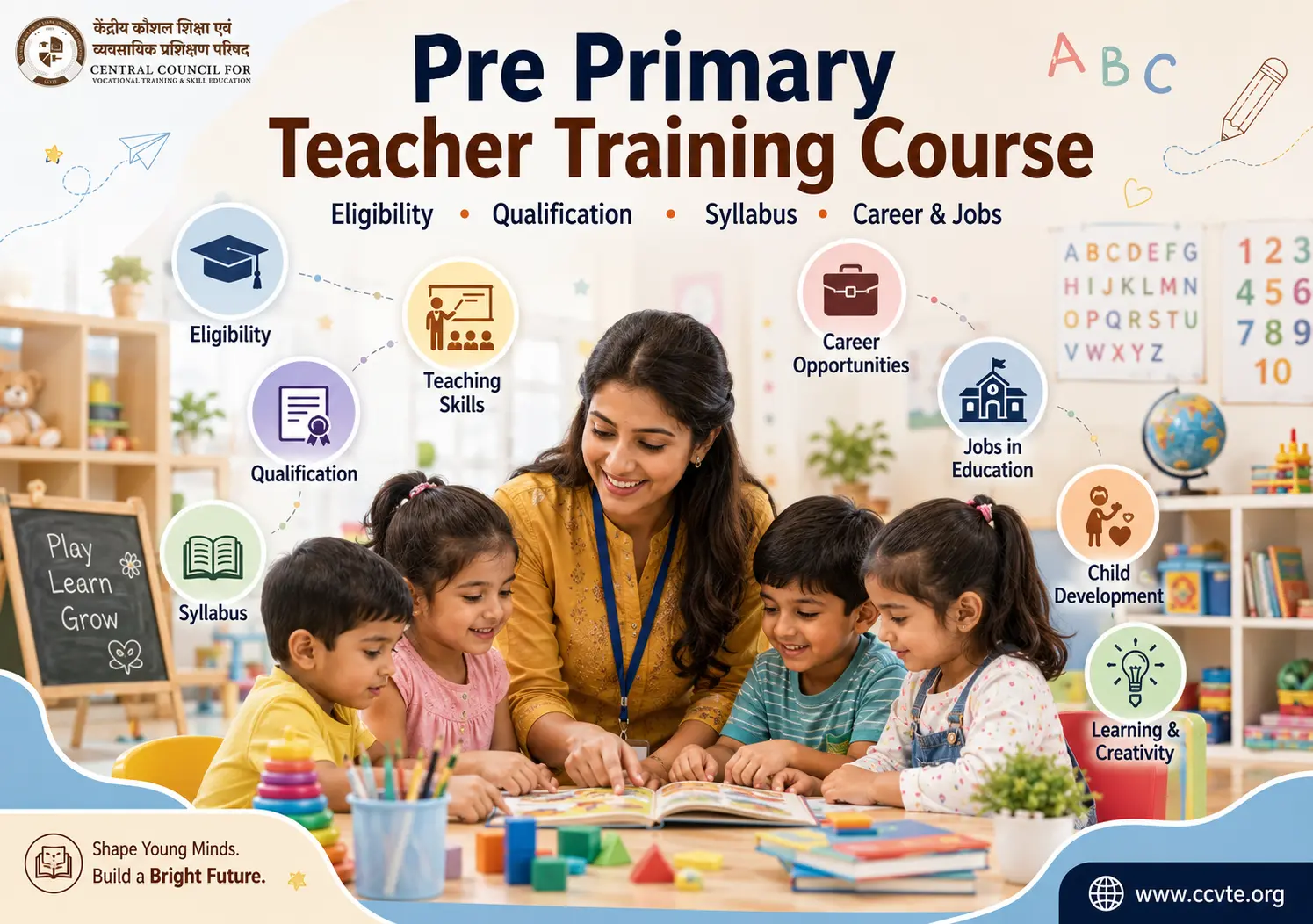
A pre primary teacher training course prepares you to teach children aged 2 to 6 through play-based learning, child psychology, and hands-on classroom practice. Also known as PPTT, it builds skills in teaching methodology, lesson planning, classroom management, and Montessori education. Open to anyone after Class 12, in any stream, the course leads to careers as a preschool teacher, nursery teacher, kindergarten teacher, or Montessori teacher. This guide covers eligibility, syllabus, certificate vs diploma options, PPTT vs NTT differences, career growth, salary factors, and how to choose the right training institute.
If you enjoy working with young children and want a stable, meaningful career, a pre primary teacher training course can be your starting point. This course prepares you to teach children between the ages of two and six, a stage when the brain develops faster than at any other point in life. During these early years, children absorb language, habits, and social skills at a pace that shapes the rest of their schooling, which is why trained pre primary teachers play such an important role.
Many people assume that teaching young children requires little formal preparation, but the reality is different. Handling a room full of toddlers, planning age-appropriate activities, and recognising early developmental delays all require specific training. A pre primary teacher training course fills this gap by combining classroom theory with hands-on practice.
In this guide, you will learn what the course covers, who should take it, what you will study, the skills it builds, and where it can take your career. By the end, you should have a clear picture of whether this path suits your goals and how to choose a course that prepares you well.
Quick Facts
Here's a snapshot before you dive into the details.
|
|
|
|
|
|
|
|
|
|
|
|
|
|
|
|
|
|
|
|
|
|
|
|
These are general patterns across institutes. Exact duration, fees, and admission steps depend on the specific course and institute you choose.
What Is a Pre Primary Teacher Training Course?
A pre primary teacher training course is a certification or diploma program that trains individuals to teach children in the early childhood age group. It focuses on child psychology, teaching methodology, and activity-based learning rather than traditional lecture-based instruction.
This training is often called PPTT (Pre Primary Teacher Training) and is closely linked with concepts under Early Childhood Care and Education (ECCE). The course prepares candidates to work in preschools, nursery schools, kindergartens, and Montessori-based learning environments. Unlike general teacher training, it places heavy emphasis on play, creativity, and hands-on classroom practice because young children learn best through experience rather than instruction alone.
Why Choose a Pre Primary Teacher Training Course?
Early childhood education shapes a child's foundation for future learning, making trained pre primary teachers essential in almost every community. Choosing this course gives you a specialised skill set that is different from mainstream teaching degrees.
Here are a few reasons this course appeals to many learners:
● It has a shorter duration compared to full teaching degrees, so you can start working sooner.
● It suits people who prefer practical, people-focused work over desk-based jobs.
● Early childhood education is a consistently needed field, since preschools operate in nearly every city and town.
● The course builds transferable skills like communication, patience, and classroom management that are valuable beyond teaching too.
Because the course blends theory with practical training, graduates typically feel classroom-ready rather than only textbook-ready.
Who Should Pursue This Course?
This course fits a wide range of learners, not just those planning a long-term teaching career. It works well for:
● Students who have just completed Class 12 and want to enter the workforce quickly.
● Career changers who want a meaningful, people-oriented profession.
● Parents who want a flexible career that can work around family schedules.
● Anyone passionate about child development, even without a background in education.
If you enjoy storytelling, creative activities, and patiently guiding young minds, this course is likely a strong fit. It does not require a background in teaching, since the program itself builds that foundation from the ground up.
Eligibility & Qualification
Eligibility requirements for a pre primary teacher training course are kept simple so more candidates can join. In most institutes, the basic criteria include:
● Completion of Class 12 (Higher Secondary) from a recognised board, in any stream.
● A minimum age requirement, which typically falls between 17 and 18 years, though this can vary by institute.
● No specific subject requirement, meaning students from science, commerce, or arts backgrounds can all apply.
Some institutes may also accept candidates with a graduate degree who want to switch careers into early childhood education. In such cases, the course can act as an add-on qualification that opens the door to early childhood roles even if the person's original degree was unrelated to teaching.
It also helps to check whether an institute expects candidates to appear for a short interview or aptitude interaction before admission. This is not common everywhere, but some institutes use it to gauge a candidate's comfort with children and communication ability. Since exact eligibility criteria can differ between institutes, it is a good idea to confirm details directly with the institute you are considering before applying.
Certificate vs Diploma: Which Should You Choose?
A certificate course is shorter and focuses on core teaching skills, while a diploma course is longer and covers the subject in greater depth. Both prepare you to teach young children, but they suit slightly different goals.
|
|
|
|
|
|
|
|
|
|
|
|
|
|
|
|
|
|
|
|
If you want to start working quickly, a certificate course may suit you better. If you are aiming for long-term growth or specialised roles like a Montessori teacher, a diploma gives you a deeper foundation. Either way, the practical training component matters more than the label on the certificate.
What Will You Learn?
The syllabus of a pre primary teacher training course is designed around how young children actually learn, not just how to deliver lessons. Rather than being a list of subjects to memorise, the course builds practical understanding step by step.
You typically begin with the basics of child psychology and child development, learning how children grow physically, emotionally, and socially during early years. From there, the course moves into teaching methodology, where you learn how to plan age-appropriate activities and structure a preschool day.
A significant part of the course focuses on learning through play, since this is the primary method used to teach preschoolers. You will study how storytelling, music, art, and movement can be used to introduce early literacy and numeracy concepts without formal instruction. Lesson planning is another core area, where you learn to design daily and weekly plans that balance academic exposure with free play.
Classroom management is also covered in depth, teaching you how to handle a group of young children, manage transitions between activities, and create a safe, engaging environment. Many programs also introduce Montessori education principles, giving you exposure to alternative teaching philosophies used in preschools worldwide.
Practical training is usually built into the course through classroom observation and teaching practice, so you graduate with real experience rather than theory alone. Many programs pair students with a mentor teacher during this practical phase, allowing you to watch real lessons before you plan and deliver your own.
The course also typically touches on basic health, hygiene, and safety practices relevant to a preschool setting, since teachers are often the first point of contact for a child's daily wellbeing. You may learn how to identify early signs of developmental concerns, how to communicate sensitively with parents, and how to maintain simple records of a child's progress. Together, these components ensure that graduates leave with a well-rounded understanding of both the academic and caregiving sides of early childhood education.
read more: Best short term couses after 12th
Skills You Will Develop
Beyond academic knowledge, this course builds a set of practical skills that shape how effective you will be in a classroom.
|
|
|
|
|
|
|
|
|
|
|
|
|
|
|
|
|
|
|
|
|
These skills are developed gradually through coursework and practical training, rather than expected on day one.
Career Opportunities After Pre Primary Teacher Training
Completing a pre primary teacher training course opens doors across several early education settings. Since preschools and childcare centers exist almost everywhere, opportunities are not limited to big cities alone.
|
|
|
|
|
|
|
|
|
|
|
|
|
|
|
|
|
|
|
|
|
Some graduates also move into private tutoring for young children or start their own small preschool setup after gaining sufficient experience. Others take up roles in special education support, working alongside trained specialists to assist children who need extra attention during early learning stages.
Career Growth Path
Career growth in this field usually moves from a classroom role toward leadership and specialisation, not in a fixed timeline but based on experience and skill. Most teachers start as an assistant or junior teacher and build up from there.
|
|
|
|
|
|
|
|
|
|
|
|
|
|
|
|
|
|
|
|
This progression depends on experience, additional certifications such as Montessori training, and demonstrated skill in classroom management rather than on the initial course alone.
Job Roles & Salary
Job roles after this course generally fall into teaching, assisting, or administrative positions within early childhood institutions. A preschool teacher typically manages a classroom directly, while a teaching assistant supports a lead teacher with activities and supervision.
What Affects Your Salary?
Salary in this field is not fixed. It depends on a combination of factors rather than the course alone.
|
|
|
|
|
|
|
|
|
|
|
|
|
|
|
|
|
|
Because these factors vary so widely, it is best to research current salary ranges specific to your city and preferred institutions rather than relying on generic figures.
Is This Course Worth It?
Yes, for the right person, a pre primary teacher training course is worth pursuing because it offers a quick, practical route into a stable and widely needed field. It suits anyone who enjoys working with children and wants meaningful, hands-on work over a desk job.
That said, it is not the right fit for everyone. If you are looking for a high-paying corporate career or dislike repetitive, patience-heavy tasks, this field may not match your expectations. The real value of this course shows up over time, as classroom experience and additional certifications open doors to better roles and pay.
Before committing, it helps to talk to working preschool teachers, understand the daily realities of the job, and compare a few institutes to see which one offers genuine practical training rather than just a certificate.
PPTT vs NTT: What's the Difference?
Pre Primary Teacher Training (PPTT) and Nursery Teacher Training (NTT) are often used interchangeably, but they can have subtle differences depending on the institute offering them.
|
|
|
|
|
|
|
|
|
|
|
|
|
|
|
|
|
|
|
|
In many institutes, PPTT and NTT courses overlap heavily in content and are treated as equivalent qualifications. If you are unsure which one to choose, look at the specific curriculum and practical training offered rather than the name alone. Someone specifically aiming to teach at the nursery level might lean toward NTT, while those wanting broader early childhood career options may prefer PPTT.
How to Choose the Right Pre Primary Teacher Training Institute
Choosing the right institute matters as much as choosing the right course, since the quality of training directly affects your classroom readiness. Keep these factors in mind while comparing options:
Curriculum: Check whether the syllabus covers child psychology, teaching methodology, and Montessori concepts in adequate depth, not just surface-level topics.
Practical Training: A strong course should include classroom observation and hands-on teaching practice, not just theory and exams.
Certification: Confirm that the certificate is recognised and accepted by preschools and childcare institutions in your region.
Faculty: Experienced trainers with real early-childhood teaching backgrounds can make a significant difference in how well concepts are explained.
Learning Support: Look for institutes that offer mentorship, doubt-clearing sessions, and placement guidance after course completion.
It also helps to speak with past students or read reviews about how well an institute's training translated into real classroom confidence. A course that looks strong on paper but offers little hands-on exposure may leave you underprepared for an actual preschool environment.
If you want to explore a structured program that covers these areas in detail, check out CCVTE's Pre Primary Teacher Training course , which walks through the curriculum, duration, and enrollment process. You can also browse CCVTE's full range of courses if you want to compare related options like Nursery Teacher Training or Montessori Teacher Training before deciding.
Common Mistakes While Choosing a PPTT Course
Many learners choose a course based on price or location alone, which can lead to weak practical training and limited job readiness. Avoiding a few common mistakes can save you time and money.
● Ignoring practical training: A course with only theory and exams leaves you underprepared for a real classroom.
● Overlooking certification recognition: A certificate that preschools in your area don't recognise limits your job options later.
● Choosing solely based on fees: The cheapest option is not always the best if it skips hands-on teaching practice.
● Not checking faculty experience: Trainers without real early-childhood teaching backgrounds often struggle to explain practical classroom situations.
● Skipping institute reviews: Past student feedback often reveals gaps that a course brochure won't mention.
Taking time to compare a few institutes on these points is more valuable than rushing into the first option you find.
Conclusion
A pre primary teacher training course offers a practical, accessible path into early childhood education. It suits Class 12 students, career changers, and anyone genuinely interested in shaping how young children learn during their most formative years. By understanding child psychology, teaching methodology, and classroom management, you become equipped to teach in preschools, nurseries, kindergartens, or Montessori settings.
Before enrolling, compare institutes carefully based on curriculum depth, practical training, and certification value, since these factors influence how prepared you will feel once you start teaching. If you are ready to take the next step, visit CCVTE's Pre Primary Teacher Training Course page (https://ccvte.org/all-courses) for detailed information on curriculum, duration, and how to enroll.
Published by CCVTE — Central Council of Vocational Training and Skill Education Delhi | +91 8595350621 | info@ccvte.org | ccvte.org

Frequently Asked Questions
Find answers to common questions