- +91 8595350621
- info@ccvte.org
- C4/97B, Keshav Puram, Delhi-110035

Nutrition Courses After 12th: Courses, Career Options & Future Scope
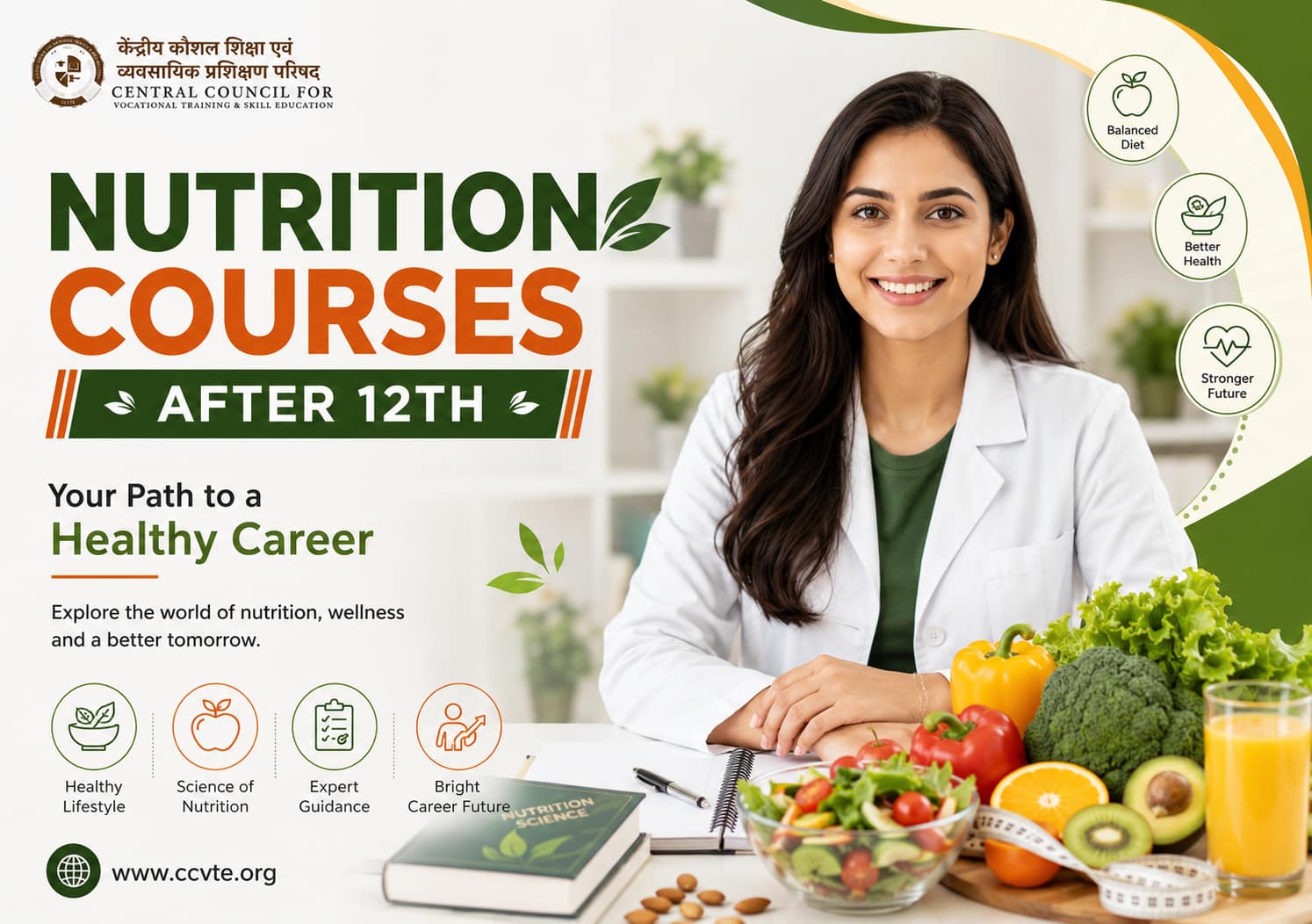
Nutrition courses after 12th include Nutrition & Dietetics, Diploma in Nutrition, Food & Nutrition, and certified nutritionist programs — each differing in duration, depth, and career direction. This guide compares all major options in a structured table, explains eligibility (typically Class 12 pass, often with a Science background), and outlines what students learn: nutritional assessment, meal planning, dietary management, and community nutrition. It clarifies the difference between a nutritionist and a dietitian, maps realistic career paths in wellness, food industry, and clinical support settings, and gives a step-by-step pathway to becoming a nutritionist in India — helping students choose the right course based on their specific goals rather than a generic ranking.
If you've just finished 12th and you're drawn to food, health, and wellness, nutrition is one of the most practical fields you can study. There are several nutrition courses after 12th — ranging from diplomas to specialised certificate programs — each suited to different goals, timelines, and career directions. This guide walks you through the main course types, eligibility, what you'll actually learn, and how to decide which path fits you best.
Nutrition sits at the intersection of science and everyday life, which is part of why it appeals to so many students. But not every course leads to the same outcome, and picking the wrong one can cost you time. So before you commit to anything, it helps to understand what's actually on offer.
Best Nutrition Courses After 12th
The most common nutrition courses after 12th include Nutrition & Dietetics programs, Diploma in Nutrition, Food & Nutrition courses, and certified nutritionist programs. Each differs in depth, duration, and career focus, so the "best" one depends on whether you want a foundational introduction, a career-focused qualification, or a specialised pathway like sports or clinical nutrition.
Here's how the major options compare:
|
Course |
Main Focus |
Suitable For |
Career Direction |
|
Nutrition & Dietetics |
Comprehensive study of nutrition science, dietary planning, and clinical concepts |
Students seeking an in-depth, career-oriented qualification |
Nutrition and wellness roles, dietary planning, clinical support settings |
|
Diploma in Nutrition |
Focused, shorter-format introduction to nutrition principles |
Students who want a quicker, skill-based entry point |
Entry-level wellness, nutrition education, food-sector roles |
|
Food & Nutrition |
Broader study combining food science with nutritional concepts |
Students interested in both food systems and health |
Food industry, nutrition education, community programs |
|
Certified Nutritionist Programs |
Applied, practice-oriented nutrition training |
Students who want hands-on, job-ready skills |
Wellness coaching, fitness-adjacent nutrition roles |
|
Sports Nutrition Pathways |
Nutrition principles applied to athletic performance and recovery |
Students interested in fitness, sports, or athlete support |
Sports and fitness organisations, wellness centres |
None of these paths guarantee a specific job outcome — that depends on the qualification level, practical exposure, and the specific role you eventually pursue. But each gives you a structured starting point.
CTA: If you're still weighing your options, it helps to look at a course that combines broad nutrition fundamentals with practical, career-relevant training — which is exactly where many students start their research.
Which Nutrition Course Is Best After 12th?
There is no single "best" nutrition course for everyone — the right choice depends on your career goal, how much time you want to invest, and whether you prefer a broad foundation or a specialised focus. A structured decision framework works better than a generic ranking.
Use these factors to narrow things down:
- Career goal — Are you aiming for clinical/dietary work, wellness coaching, food industry roles, or nutrition education?
- Curriculum depth — Does the course cover nutrition science in enough detail for your goals, or is it more introductory?
- Eligibility — Does your current academic background meet the course's requirements?
- Duration — Are you looking for a shorter diploma or a more comprehensive program?
- Certification value — Is the certificate recognised and relevant to the career path you want?
- Practical learning — Does the course include applied learning, case studies, or hands-on components?
- Credibility of the institution — Is the course delivered by a recognised training provider?
- Career relevance — Does the course content map to real, current roles in the nutrition and wellness sector?
A simple way to think about it: if your goal is a broad, career-oriented qualification, a comprehensive program like Nutrition & Dietetics is usually a stronger starting point than a narrow, single-topic certificate. If you want a faster entry into wellness-adjacent work, a focused diploma may suit you better.
Eligibility for Nutrition Courses After 12th
General eligibility for most nutrition courses after 12th requires completion of Class 12 from a recognised board, often (though not always) with Science or a related stream, depending on the specific course and institution. Exact eligibility criteria vary by course, so it's important to check the specific requirements rather than assume a blanket rule.
A few points worth understanding clearly:
- General eligibility usually means a pass in 12th grade from a recognised board.
- Course-specific eligibility can vary — some programs prefer a Science background (particularly Biology or Home Science), while others accept students from any stream.
- Qualification-specific requirements apply more strictly to advanced or specialised programs, where a stronger academic foundation may be expected.
It's not accurate to say that any student from any stream can automatically qualify for every nutrition-related course or role — eligibility depends on the specific program and, later, on the specific career path (some roles require additional professional qualifications). Always verify eligibility directly with the course provider before applying.
What Do You Learn in a Nutrition Course?
Nutrition courses typically cover the science of nutrients, food composition, nutritional assessment, meal planning, dietary management, and applied topics like community and wellness nutrition. The exact curriculum depth depends on whether the course is a short diploma or a more comprehensive program.
Common areas of study include:
- Nutrition fundamentals — macronutrients, micronutrients, and how the body uses them
- Food science — food composition, processing, and safety basics
- Nutritional assessment — evaluating dietary intake and nutritional status
- Meal planning — building balanced, practical meal structures
- Dietary management concepts — adapting nutrition guidance to different needs
- Health and wellness — the broader relationship between nutrition and lifestyle
- Community nutrition — nutrition education and outreach at a population level
- Practical nutrition knowledge — applying theory to real-world scenarios
More comprehensive programs, such as Nutrition & Dietetics courses, tend to go deeper into each of these areas and add structured, applied components — which is one reason they're often chosen by students planning a longer-term career in the field.
Nutrition and Dietetics as a Career Option
Nutrition and Dietetics is one of the more comprehensive nutrition-related educational pathways, combining nutrition science with dietary planning and applied wellness concepts. It suits students who want a structured, in-depth qualification rather than a narrow, single-focus certificate, and it connects to a wider range of nutrition and wellness-related career directions.
Students interested in this field typically enjoy science, problem-solving, and working directly with people's health and lifestyle needs. The program builds skills in areas like nutritional assessment, meal and diet planning, and applied wellness concepts — skills that are relevant across wellness centres, community health initiatives, food and nutrition-focused organisations, and education settings.
Because it offers broader coverage than a short diploma, Nutrition & Dietetics is often a natural next step for students who've explored the basics of nutrition and want a more structured, career-oriented qualification. If you'd like to see how this course is structured in detail — including its curriculum, duration, and eligibility — you can explore the Nutrition and Dietetics course at CCVTE.
CTA: If comprehensive, career-focused training is what you're after, this is a good point to look closely at what a Nutrition and Dietetics program actually covers.
Career Options After Nutrition Courses
Nutrition-related career pathways can include wellness and nutrition education roles, community nutrition programs, fitness and wellness-sector positions, food and nutrition industry roles, and sports nutrition-adjacent work — with the specific opportunities depending on the qualification, specialisation, and experience level.
Realistic directions to consider include:
- Wellness and nutrition education — guiding individuals or groups on general nutrition principles
- Community nutrition — supporting nutrition awareness and outreach programs
- Fitness and wellness sector — working alongside gyms, wellness centres, or fitness programs
- Food and nutrition industry — roles connected to food products, labelling, or nutrition communication
- Sports nutrition pathway — supporting athletes or fitness enthusiasts with nutrition-related guidance, typically after additional specialisation
It's worth being realistic here: employment outcomes depend on the specific qualification, the depth of practical training, and how the individual builds experience over time. No course can guarantee a job, and it's reasonable to expect that more comprehensive, practically-oriented programs tend to open up a wider range of opportunities than narrow, short-format certificates.
How to Become a Nutritionist in India
A typical pathway toward nutrition-related roles in India starts with completing Class 12, followed by a relevant nutrition education program, further skill development, practical exposure, and then pursuing suitable career opportunities. Exact professional requirements can vary depending on the specific role, employer, and industry.
A general pathway looks like this:
- Complete Class 12 from a recognised board.
- Choose a relevant nutrition course — a diploma, certificate, or comprehensive program like Nutrition & Dietetics, based on your goals.
- Build practical skills — through case studies, projects, or applied coursework included in the program.
- Gain exposure — via internships, practical training, or supervised learning opportunities where available.
- Explore relevant roles — in wellness, community nutrition, food industry, or education, depending on your qualification.
Because requirements differ by role and setting, it's a good idea to research the specific expectations of the career direction you're targeting rather than assuming one course automatically qualifies you for every nutrition-related job.
Nutritionist vs Dietitian
Nutritionist and dietitian are related but distinct terms. Broadly, "nutritionist" is often used for professionals focused on general nutrition guidance and wellness, while "dietitian" is typically associated with more clinically-oriented dietary work, often within healthcare-adjacent settings. Exact usage and qualification requirements can vary, so it's worth checking role-specific expectations.
|
Aspect |
Nutritionist |
Dietitian |
|
General focus |
Broad nutrition guidance, wellness, and lifestyle advice |
Dietary planning often linked to clinical or health-focused contexts |
|
Typical work context |
Wellness centres, community programs, fitness settings |
Healthcare-adjacent or clinically-oriented settings |
|
Qualification considerations |
Varies by role; often built on foundational or comprehensive nutrition education |
Often expects more specialised or clinically-focused training |
|
Career environment |
Wellness, education, food industry, fitness sector |
Hospitals, clinics, and structured healthcare-adjacent environments |
|
Role difference |
Focuses more on general dietary and wellness guidance |
Focuses more on structured, condition-specific dietary planning |
These terms are sometimes used loosely in everyday conversation, so it's important to look at the specific qualification and role requirements rather than assuming the titles are interchangeable everywhere.
Diploma in Nutrition vs Nutrition & Dietetics
A Diploma in Nutrition is typically a shorter, more focused introduction to nutrition concepts, while Nutrition & Dietetics programs generally offer broader, more in-depth coverage of nutrition science and dietary planning. Neither is automatically "better" — the right choice depends on your timeline and career goals.
|
Aspect |
Diploma in Nutrition |
Nutrition & Dietetics |
|
Course focus |
Introductory, foundational nutrition concepts |
Comprehensive nutrition science and dietary planning |
|
Depth |
Lighter, more condensed |
More detailed and structured |
|
Learning objectives |
Quick, practical understanding |
In-depth, career-oriented understanding |
|
Suitable learner |
Students wanting a faster entry point |
Students planning a longer-term, structured career path |
|
Potential career direction |
Entry-level wellness or food-sector roles |
Broader range of nutrition and wellness-related roles |
If you're unsure which fits you, ask yourself whether you want a quick foundational start or a more comprehensive, career-building qualification — that single question usually points you toward the right option.
How to Choose the Best Nutrition Course in India
Choosing the right nutrition course comes down to matching the course structure — eligibility, curriculum, duration, and practical learning — with your specific career goals, rather than picking based on course name alone.
Use this checklist before making a decision:
- Eligibility — Do you meet the academic requirements?
- Curriculum — Does it cover the topics relevant to your goals?
- Duration — Does the timeline fit your plans?
- Certification — Is the certificate meaningful and relevant to the career direction you want?
- Practical learning — Does the course include applied or hands-on components?
- Institution/course credibility — Is it delivered by a recognised training provider?
- Career relevance — Does it align with real opportunities in the field?
- Learning format — Does the delivery mode (in-person, online, or hybrid) suit your situation?
- Admission process — Is the application process clear and manageable?
If you're looking for a course that checks most of these boxes — solid curriculum depth, practical learning, and clear career relevance — it's worth reviewing a comprehensive option like the Nutrition and Dietetics program at CCVTE to see how it's structured.
CTA: Once you've worked through this checklist, comparing your shortlist against a program like Nutrition & Dietetics can help you confirm whether it matches what you're looking for.
Final Takeaway
Nutrition courses after 12th open up a genuinely practical field — one where the right course can shape whether you head toward wellness, community nutrition, food-industry work, or more clinically-oriented dietary paths. Rather than chasing the "most popular" course, match your choice to your actual goals: eligibility, curriculum depth, practical exposure, and long-term relevance matter more than a course's name alone.
If you've worked through the comparisons and checklist in this guide and you're leaning toward a comprehensive, career-oriented qualification, it's worth taking a closer look at the Nutrition and Dietetics course at CCVTE to see if it fits your goals.
CTA: Still comparing your options? Reviewing the full course structure, eligibility, and curriculum on CCVTE's Nutrition and Dietetics page is a solid next step before you decide.
Published by CCVTE — Central Council of Vocational Training and Skill Education Delhi | +91 8595350621 | info@ccvte.org | ccvte.org
Frequently Asked Questions
Find answers to common questions