- +91 8595350621
- info@ccvte.org
- C4/97B, Keshav Puram, Delhi-110035

Child Care Courses After 12th: Eligibility, Types, Fees & Job Opportunities
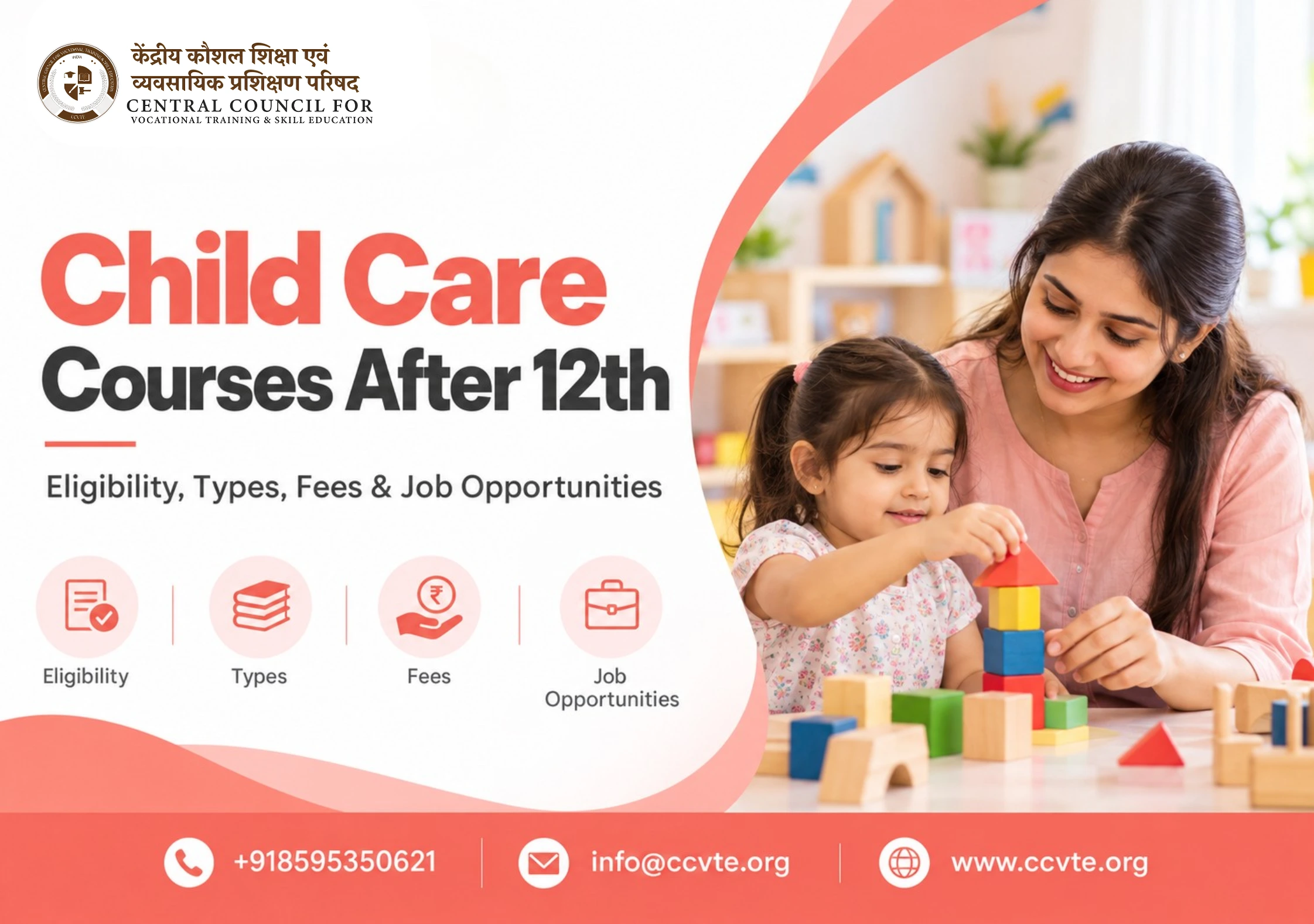
A practical guide to child care courses after 12th, covering eligibility, course types, fees, the ECCE syllabus and career options.
Child care courses are certificate, diploma and degree programmes that train you to care for, teach and support children from birth to about eight years of age. After Class 12, you can choose a short certificate in early childhood care and education (ECCE), a two-year diploma such as D.El.Ed, or a four-year degree such as B.El.Ed or a B.Sc in Child Development. Most programmes accept a Class 12 pass from any stream, and fees run from a few thousand rupees for a short certificate to a few lakh for a full degree. Graduates work as preschool teachers, daycare managers, Anganwadi workers, early-learning coordinators and NGO programme staff. The hard part is not finding a course. It is knowing which one is recognised, which one can lead to a government post, and which one only hands you a certificate to frame. This guide sorts that out, step by step.
Key Takeaways
• Who can apply: Most programmes need a Class 12 pass from a recognised board, and arts, science and commerce students are usually all eligible.
• Course levels: You can start with a certificate (a few months), move to a diploma (one to two years) or go for a degree (three to four years).
• ECCE is the core: An early childhood care and education (ECCE) course covers child development, play-based learning, nutrition, safety and parent communication.
• Recognition matters more than the name: For teaching in schools, check NCTE or UGC recognition before paying a single rupee.
• Fees vary widely: Government and aided institutes cost far less than private ones, so compare the full cost, not just the tuition line.
• Jobs are real but start modest: Preschools, daycare centres, corporate creches, NGOs and Anganwadi services hire, and pay grows with qualification and experience.
• Practical training decides outcomes: A course with a proper internship beats a longer course with none.
What Is a Child Care Course?
A child care course trains you in how young children grow, learn, stay safe and stay healthy. Think of it as a mix of psychology, nutrition, teaching method and first aid, all pointed at the early years. Some programmes lean towards classroom teaching. Others lean towards care, health and community work.
What you actually study
Expect subjects like child development stages, play-based learning, nutrition and hygiene, child safety, first aid, working with parents, observation and record keeping. Many courses also add a module on running a preschool or daycare. You will spend real time in classrooms, planning activities and watching how a three-year-old reacts when the story ends.
How it differs from teacher training and nursing
A child care course is not a nursing degree. It is also not the same as a full school-teaching qualification, although some programmes overlap. If you want a primary school post in a government school, you need a recognised teacher education programme. If you want to run a daycare or work with infants, a child care programme fits better.
Child Care Courses After 12th: Eligibility and Entry Requirements
Child care course eligibility is gentler than most professional programmes. In most cases you need to have passed Class 12 from a recognised board, and your stream rarely matters. Rules shift a little between certificates, diplomas and degrees, so check each one.
Basic eligibility
For certificate programmes, a Class 12 pass is usually enough, and some institutes even admit students who have passed Class 10. Diplomas and degrees generally ask for Class 12. Teacher education diplomas such as D.El.Ed usually ask for around 50 percent marks, with relaxation for reserved categories. State rules differ, so read the current prospectus.
Age, stream and marks
Most certificate programmes have no strict upper age limit. Diplomas that feed into government teaching may set a minimum age and a marks cut-off. Arts students often have an easier time with the language and child psychology papers, but science and commerce students do just as well.
Entrance exams and admission process
Many state D.El.Ed seats are filled through a state entrance test or a merit list. Some universities accept CUET UG scores for degrees in child development, while others admit on Class 12 merit. The four-year Integrated Teacher Education Programme (ITEP) is admitted through the NCET. Private certificate courses usually need only an application and a short interaction.
Types of Child Care Courses After 12th
The right pick depends on how fast you want to start working and whether you need a recognised teaching qualification. Here is a quick comparison.
|
|
|
|
|
|
|
|
|
|
|
|
|
|
|
|
|
|
|
|
|
|
|
|
|
|
|
|
|
|
|
|
|
|
|
Certificate and short-term courses
These are the fastest way in. A certificate suits you if you want to work in a daycare, assist in a playschool or build a base before a longer course. The catch is that a certificate alone rarely opens government doors.
Diploma courses
A diploma gives you more depth and often a better shot at a lead teacher role. NTT is widely accepted by private preschools. It is generally not treated as a teaching qualification for government school posts, so do not confuse it with D.El.Ed.
Undergraduate degrees
Degrees take longer but give the widest range. A B.Sc in Child Development leads towards programme, research and counselling-support roles. B.El.Ed and ITEP lead towards teaching. If you prefer a shorter, skill-focused route, browse the skill and diploma courses at CCVTE before you commit to a longer degree.
Early Childhood Care and Education (ECCE) Course: Syllabus and Practical Training
An early childhood care and education (ECCE) course focuses on the years from birth to eight. Under the National Education Policy 2020, this stretch is treated as the foundation of all later learning, covering three years of preschool and the first two years of primary school. That is why ECCE has moved from “optional extra” to a serious career track.
What an ECCE syllabus usually covers
• Child growth and development, from infancy to early primary years
• Play-based and activity-based learning methods
• Early language, reading readiness and early numeracy
• Nutrition, hygiene, safety and basic first aid
• Inclusive education and spotting early signs of learning difficulties
• Working with parents and communities
• Classroom management, observation and documentation
Practical training and internships
Ask how many weeks of classroom practice the course includes. A good ECCE programme places you in a preschool, a daycare or an Anganwadi centre, where you plan and run sessions under supervision. You also build activity files and observation records. Those become your portfolio when you apply for jobs.
Child Care Courses Fees in India: What to Expect
Fees depend on four things: whether the institute is government, aided or private, the level of the course, the city, and what the fee covers. Some courses bundle books, practical kits and internship placement. Others charge for each separately.
Indicative fee ranges
These ranges are rough guides, not official figures. Always confirm with the institute.
|
|
|
|
|
|
|
|
|
|
|
|
|
|
|
Costs students forget to ask about
Ask about exam fees, practical material, uniform, internship travel and any registration charge. Also be careful with promises of “guaranteed placement”. A fair institute shows you where past students actually work.
Child Care and ECCE Programmes at CCVTE
The Central Council of Vocational Training and Skill Education (CCVTE) runs skill programmes in several fields, and its course list includes early childhood and teacher-training categories: Child Care and Education, Early Childhood Care and Education, Montessori Teacher Training and Pre-Primary Teacher Training. Programmes are offered as diplomas of 3 months, 6 months or 1 year, and as a 2-year advanced diploma.
How learning works
Classes and study material run through an online learning management system, with an e-library and online examinations, so you do not have to travel to a campus for exams. Counsellors are available for student support, and the curriculum includes entrepreneurial training, which helps if you plan to open a playschool or daycare. CCVTE also lists career guidance and placement support.
Before you enrol
Open the CCVTE courses page for the current list, duration and fee of each programme, and check the authorised centres in India if you want a centre near you. Ask for the approval documents of the programme and centre, and confirm what the qualification can be used for. A diploma suits private preschool and daycare work. For a government teaching post, you will still need a recognised teacher education qualification.
How to Choose the Right Child Care Course
Start with your goal, then work backwards. Want to teach in a government school? Pick a recognised teacher education programme and plan for a TET. Want to open your own playschool? An ECCE diploma plus experience works well. Want NGO or programme work? A child development degree fits.
Check recognition first
For teacher education, look for NCTE recognition. For degrees, confirm that the university is UGC approved. A course without recognition can cost you years. If a college cannot show its approval letter, walk away.
Look at internship, faculty and placement
Ask who teaches the course and what the students do in the final semester. Speak to a recent graduate if you can. Their answer about the internship will tell you more than the brochure.
Online or offline?
Some diplomas and certificates run online or in blended mode, which suits working students. Practical training still has to happen somewhere real, so confirm how the institute handles it. Also check whether the online mode is accepted for the recognition you need.
Job Opportunities After Child Care Courses
Job opportunities after child care courses are growing because more families want structured early learning, and more employers offer creche facilities. Companies with 50 or more employees are required to provide creche access under the Maternity Benefit (Amendment) Act, 2017, which has opened more roles in corporate daycare.
Common roles
• Preschool or nursery teacher: Plan activities, teach early literacy and numeracy, and talk to parents.
• Daycare or creche manager: Run daily operations, staff, safety and parent communication.
• Anganwadi worker or supervisor: Work under the Integrated Child Development Services (ICDS) scheme. Eligibility and selection rules vary by state.
• Early-learning coordinator or curriculum assistant: Support lesson planning for preschool chains and ed-tech companies.
• NGO programme associate: Work on child nutrition, early stimulation and community education projects.
• Primary teacher: Possible after a recognised D.El.Ed, B.El.Ed or ITEP, along with TET or CTET where required.
Where you can work
Private preschool chains, international schools, corporate creches, NGOs, hospitals with child programmes, and government child development services all hire. Many graduates also start their own playschool or home daycare after a few years of experience.
What about salary?
Starting pay in private preschools is modest. In smaller cities it often sits in the low teens of thousands per month, and it is higher in metros and international schools. Your pay grows with a degree, a recognised teaching qualification and a record of good parent feedback. Treat any claim of a high starting salary with caution.
Skills That Help You Stand Out
Certificates get you an interview. These get you the job. Patience comes first, because small children test it daily. Add clear spoken communication, storytelling, basic first aid, calm handling of worried parents, and simple digital skills for reports and parent updates.
Quick Checklist Before You Enrol
1. Decide your goal: private preschool, government school, daycare, NGO or your own playschool.
2. Confirm that you meet the child care course eligibility for that programme.
3. Check NCTE or UGC recognition and ask for the approval letter.
4. Read the syllabus and confirm it includes an ECCE practical component.
5. Ask for the full fee, including exams, material and internship costs.
6. Speak to a current student or a recent graduate.
7. Compare two or three institutes before paying a booking amount.
Ready to compare options? Visit the CCVTE home page, read the FAQs or contact the CCVTE team with your questions. You can also read our guides on the CMS ED course, the warehouse management course and makeup artist course fees.
Frequently Asked Questions
Find answers to common questions